

Global Food Initiative: Inside Osogbo’s Cheap-Food Ponzi Scheme, The Website, Phone Trail And Missing Millions

Reloaded News Desk
What began in Osogbo, Osun State, as an unusually cheap-food programme has turned into a crisis involving stranded customers, an abandoned outlet, a looted warehouse and an ongoing police investigation.
The organisation, Global Food Initiative, began operating around the Odi-Olowo area of Osogbo in early August, according to customers and reports from the scene.
Its model was straightforward; customers paid in advance for food commodities offered at prices substantially below prevailing market rates and were asked to return after about seven days to collect their orders.
A 50kg bag of rice was reportedly advertised for ₦27,000, while customers were quoted ₦30,000 for 25 litres of Kings vegetable oil, ₦8,000 for five litres of Golden Terra oil, ₦10,000 for a carton of spaghetti and ₦12,000 for a carton of Maggi. At the time, customers reported substantially higher prevailing market prices.
The arrangement initially appeared to work.
Some early customers reportedly received the food they had paid for. That success helped generate confidence and attracted traders, workers and other residents who subsequently made larger payments.
Then the system broke down.
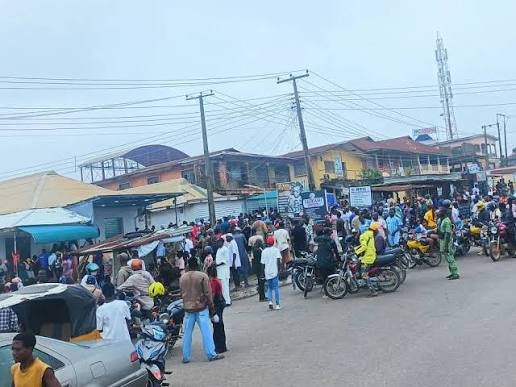
By Monday, September 28, customers who had reached the end of their waiting periods arrived at the Odi-Olowo premises to collect their food but found the operators unavailable. Some customers said they had paid hundreds of thousands or millions of naira.
One customer, Mistura, said she paid ₦300,000 for 11 bags of rice. Another, identified as Olamide, said she paid ₦1.2 million for assorted food items intended for her stepdaughter’s wedding. Other customers displayed receipts involving substantially larger amounts, although the total amount collected by the operators has not been independently established.
The police initially went to the premises to prevent a breakdown of law and order. By Tuesday, the situation had deteriorated further.
Residents and others forced their way into the warehouse and removed rice, noodles, cooking oil and other food items.
Who exactly was operating Global Food Initiative?
The business left remarkably little behind
Our review of the available records and published investigations found that the organisation’s public-facing footprint was surprisingly small.
Its physical outlet displayed two telephone numbers:
0907 379 1569
0916 325 9583
According to investigation, both numbers became unreachable after the crisis. Searches linked the second number, which was also connected to WhatsApp, to a person identified as Usman Adamu.
That finding, however, does not establish that Adamu owned or operated Global Food Initiative.
The WhatsApp profile associated with the number reportedly carried a promotional image for an entertainment event connected to Charlie Lounge in Osogbo. Charlie Lounge subsequently told FIJ that neither it nor the entertainer shown in the image had any connection with the number and alleged that its image had been used without authorisation.
The first telephone number produced no comparable ownership information in FIJ’s checks.
Both numbers were reportedly unreachable when investigators attempted to contact them.
The website raises another question
Global Food Initiative also operated a website, globalfoodsinitiative.com.
According to domain information examined by FIJ, the domain was registered on June 26, 2026, barely weeks before the food operation appeared in Osogbo.
The registration used a privacy service and an address in Lewes, Delaware, United States, with the registrant’s identity withheld from public WHOIS information.
The timing is significant as an investigative lead, but it is not evidence of wrongdoing by itself.
A recently registered domain and privacy-protected registration can be perfectly legitimate. What matters is whether investigators can establish who actually commissioned the website, paid for the domain and controlled its content and payment channels.
That information is not presently available from the public record we reviewed.
And then there is the bank account
At least one customer told reporters that she paid ₦1.2 million into an account bearing the name Global Food Initiative at an online microfinance bank.
This may be one of the most important investigative leads in the entire case.
The decisive information is not simply the name displayed on the account.
It is the KYC record behind the account.
Who opened it?
What identification documents were supplied?
Which BVN or NIN was linked to it?
Who were the authorised signatories?
Where did the incoming deposits go?
Were the funds transferred to other accounts?
Were substantial withdrawals made shortly before the operators disappeared?
Those answers are potentially capable of moving the investigation from speculation to evidence.
And The CAC registration
Our searches did not identify a publicly indexed Corporate Affairs Commission record conclusively establishing a Nigerian company or business name registered as Global Food Initiative.
That does not prove the organisation was unregistered.
It could have operated under another legal name, a registered proprietor, a different corporate entity or a business name that is not readily discoverable through ordinary web indexing.
The CAC registry therefore remains an important outstanding line of inquiry.
Investigators should establish whether:
- Global Food Initiative was registered;
- another company operated under the name;
- the website’s operators were connected to any Nigerian company;
- the premises were leased in the name of an individual or company; and
- the person who controlled the bank account was legally connected to the business.
What the police know
The Osun State Police Command initially said no affected customer had formally lodged a complaint when officers first arrived at the scene.
The command has since said an investigation has commenced and urged victims to come forward with information.
Police spokesman Abiodun Ojelabi said the victims’ cooperation was necessary to assist the investigation.
That means the case is still at an early investigative stage.
There is presently no verified evidence that the police have arrested or publicly identified the ultimate operators.
The money trail is now the real story
Customers have mentioned payments ranging from hundreds of thousands of naira to tens of millions.
One customer reportedly claimed that a woman paid ₦35 million, while another receipt reportedly showed ₦10 million. A separate report cited an alleged investment of about ₦6 million, while another report mentioned a customer claiming to have put as much as ₦50 million into the scheme. These are individual claims and should not be added together as an established total.
The warehouse contained actual food commodities, and some customers had previously received goods. That makes the central question more complicated than simply determining whether the business existed.
The investigation must establish how the business was financed, how customer payments were handled, what stock was purchased, how much stock remained when the operators disappeared and where the money went.
Those answers will require more than interviews with angry customers.
They require the bank records, CAC records, tenancy documents, telecommunications information, domain-registration records and the police investigation.
Until those records are obtained and examined, the identities of the ultimate operators and the precise fate of customers’ money remain unresolved.