
UNGA 81: AI Emerges As New Global Power Struggle As Nations Fight Over Rules, Access And Control

Reloaded News Desk
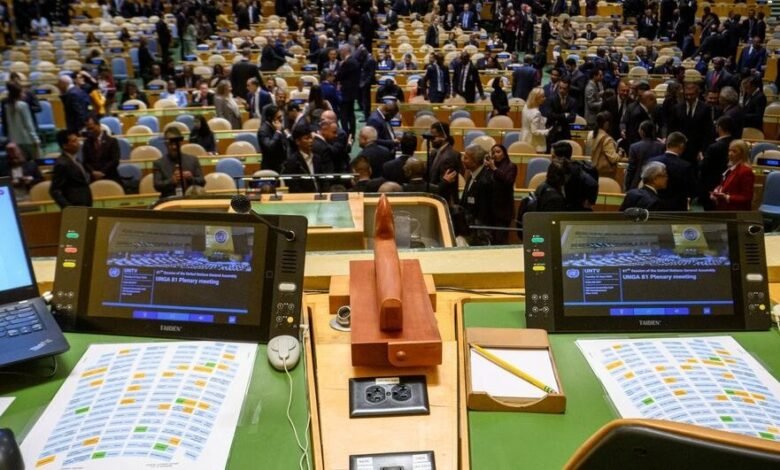
Artificial intelligence has moved from the margins of international diplomacy to the centre of the global power debate, with countries at the 81st United Nations General Assembly confronting a fundamental question: who will control the technology that increasingly shapes economies, security and societies?
The scale of the shift was underlined by the President of the UN General Assembly, who disclosed that 128 delegations addressed artificial intelligence during this year’s General Debate, compared with only five, four years ago.
AI was discussed not simply as a technology but as an issue of governance, development, sovereignty, security and access.
The UN General Assembly president identified four questions at the heart of the emerging debate; who designs AI, who benefits from it, who bears its risks and who is accountable when harm occurs.
The concern is that the technology could create another global divide if a small number of countries and companies control the data, computing capacity and rules that determine how AI develops.
The United Nations has already established a Global Dialogue on AI Governance, giving countries a multilateral forum to discuss access, safety, accountability, infrastructure, data, skills and international standards. The next session is scheduled for New York in May 2027.
US Pushes Sovereignty
The United States has taken a markedly sovereignty-focused position.
Addressing the General Assembly, President Donald Trump rejected what he described as a global scheme for controlling artificial intelligence, saying the technology would be referred to officially by his administration as “Super Intelligence.”
The position places American technological development and national control ahead of a broad international regulatory framework.
China Wants A Different Model
China has argued for open and inclusive AI development, while insisting that digital sovereignty and the interests of developing countries must be protected.
At a UN Security Council meeting on AI and international security, China’s Ambassador Fu Cong said AI should not become a technology controlled by rich countries and rich people.
Beijing has also promoted greater AI capacity-building for developing countries, including training programmes and international AI cooperation centres.
Europe Calls For Regulation
The European Union has taken a more regulation-oriented position.
European Council President António Costa told the General Assembly that AI requires an accountable, transparent and regulated architecture, arguing that the industry should not effectively be regulated by a small number of major technology companies.
He called for the UN to play a central role in establishing global standards through existing UN digital and AI governance mechanisms.
The Developing World Wants A Seat At The Table
For developing countries, the issue extends beyond regulation.
The UN General Assembly president has warned that most countries remain outside the rooms where many of the most consequential AI decisions are being made.
He said fewer than one-third of developing countries have national AI strategies, highlighting a widening capacity gap between countries building advanced systems and those still trying to establish the infrastructure, skills and policy frameworks needed to use them.
The UN’s emerging framework therefore places emphasis on access to computing capacity, infrastructure, data and skills alongside safety and accountability.
Africa And Nigeria
For Africa, the AI debate is becoming inseparable from the continent’s broader struggle over technology, data, skills and economic sovereignty.
Nigeria has already identified AI-enabled digital services as part of its strategy to participate in the global digital economy. At the UNGA sidelines, the Federal Government also promoted the Hire From Nigeria initiative, targeting one million export-linked jobs by 2030 from an estimated 20,000 today.
The emerging global contest therefore goes beyond which country builds the most powerful AI model.
It is increasingly about who owns the infrastructure, controls the data, develops the talent, writes the standards and captures the economic value.
At UNGA 81, artificial intelligence has unmistakably become part of that wider contest for influence.
Reloaded News — NEWS THAT INFORMS. MEDIA THAT TRANSFORMS