
Questioning The Formidability Of Peter Obi In 2027 Presidential Election By Adeboye Adebayo

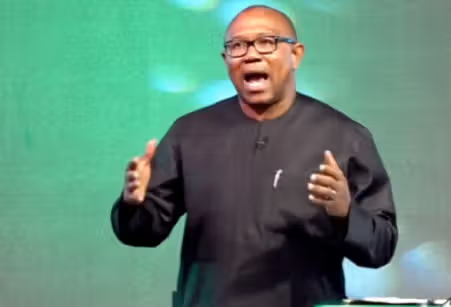
By Adeboye Adebayo
I always wonder why media houses and other few Nigerians always describe the former governor of Anambra State; Peter Obi as formidable in the upcoming Presidential election. Although, the political conversation surrounding the 2027 presidential election may not be complete without a critical examination of Peter Obi, the Labour Party presidential candidate in the 2023 election. His emergence as a major opposition figure attracted considerable public enthusiasm, particularly among young Nigerians who identified with his message of prudent financial management, accountability and a departure from established political practices.
However, public enthusiasm and political reputation are not substitutes for a comprehensive examination of a politician’s record, organisational capacity and preparedness for the responsibilities of national leadership.
As the 2027 election approaches, there are important questions about Obi’s eight-year administration in Anambra, the accuracy and interpretation of some of his public claims, his political party affiliations, the strength of his national political structures and his ability to sustain a broad opposition coalition.
One of the most frequently repeated features of Obi’s political identity is his reputation for financial prudence. He has consistently presented his administration as one that prioritised savings, investments and responsible management of public resources.
Yet, this reputation deserves closer examination against available financial records.
The Debt Management Office’s figures show that Anambra’s external debt stood at approximately $16.87 million in December 2006 and increased to approximately $30.32 million by December 2013. The state’s domestic debt was recorded at approximately ₦3.03 billion in December 2013.
A September 2026 investigation by Premium Times also examined the controversy surrounding eight external loan facilities, which the Anambra State Government says were contracted during Obi’s administration and had a combined original value of $123.77 million.
Obi disputes the government’s interpretation of those facilities. The investigation established that the precise outstanding balance on the date he handed over in March 2014 cannot be determined from the available DMO records.
Nevertheless, the figures raise an important question about the sweeping presentation of his administration as having left Anambra without public debt. A claim of financial prudence should withstand scrutiny of the actual liabilities, loan facilities, disbursements and financial obligations inherited by successive administrations.
The public deserves a complete account, not merely a political narrative built around savings and investments.
Another important aspect of Obi’s administration is the prolonged absence of elected local government councils in Anambra State.
Local government elections were eventually conducted on January 11, 2014, shortly before Obi left office. The state went from 1998 until January 2014 without local government elections. For almost the entirety of Obi’s administration, grassroots government operated without elected councils.
Why did an administration that promoted accountability and good governance preside over such an extended period without elected local government representatives?
Democratic accountability cannot be confined to the federal and state levels. Local government remains an important tier of government through which citizens participate in decisions affecting their immediate communities.
Education is another area that deserves serious examination.
The problem of examination malpractice and so-called miracle examination centres has remained a concern in Nigeria. These centres undermine educational standards by rewarding examination fraud rather than genuine learning.
However, establishing that such centres specifically escalated under Obi’s administration requires comparative examination of examination records, malpractice statistics and regulatory reports covering the period.
The question should be whether Anambra’s education system made measurable progress in learning outcomes, examination integrity, teacher quality and access to quality education during his tenure.
A politician who seeks to lead a country must be prepared to have his educational record examined beyond the number of schools visited, institutions supported or financial allocations announced.
Obi’s public statements about Anambra’s financial legacy have also generated disagreements.
His assertion that he left office without owing anybody has been challenged by available debt records. The distinction between unpaid contractor invoices, pension arrears, salaries and formal public debt is important, but a public claim that a state had no debt must account for all relevant financial obligations.
The broader issue is the responsibility of political leaders to provide accurate, properly contextualised figures.
When a politician repeatedly builds a national political identity around financial competence, the accuracy of the figures used to support that identity becomes particularly important.
The same standard should apply to claims about economic growth, poverty, investment, employment, public expenditure and the performance of government institutions.
One of the most consequential questions surrounding Obi’s 2027 ambition is the gap between his public following and the institutional strength of the political platform through which he seeks power.
His 2023 presidential campaign demonstrated considerable mobilisation capacity. Yet, the Labour Party’s prolonged internal crisis exposed the vulnerability of a political movement whose national influence had not translated into a stable and broadly consolidated party institution.
Obi left the Peoples Democratic Party in May 2022 and joined the Labour Party two days later. Following the 2023 election, the Labour Party became embroiled in a prolonged leadership dispute. Obi subsequently left the party and joined the African Democratic Congress in December 2025.
He registered with the ADC in March 2026 but announced his departure in May 2026. He and Rabiu Kwankwaso subsequently joined the Nigeria Democratic Congress.
These developments raise legitimate questions about political continuity and institution-building.
A presidential aspirant needs more than a popular name, a large online following and enthusiastic supporters. A credible national political organisation requires functioning ward structures, state and local government coordinators, membership systems, transparent financing, effective communication, disciplined leadership and reliable polling-unit operations.
Obi’s political journey has also exposed the difficulties of building a united opposition.
The ADC coalition brought together prominent political figures, including former Vice-President Atiku Abubakar and other opposition leaders. The objective was to establish a common platform capable of challenging the ruling party in 2027.
However, disagreements, internal disputes and competing political interests complicated the arrangement. Obi’s departure, alongside Kwankwaso’s, further weakened the coalition’s original unity project.
This development raises a fundamental question about the ability of opposition leaders to place collective political objectives above individual ambitions.
A presidential campaign requires alliances across regions, political tendencies and influential constituencies. Such alliances cannot be sustained by public declarations alone. They require trust, negotiation, compromise and a clearly defined agreement on leadership and political direction.
The ability to build and maintain such relationships is an important part of presidential politics.
There have also been allegations and public questions concerning Obi’s financial relationships and his association with Fidelity Bank.
These issues deserve scrutiny, particularly where public resources, government guarantees or financial institutions are involved.
Separately, the Pandora Papers investigation raised questions about his offshore business interests and declarations while in public office. In September 2026, Premium Times reported that the Code of Conduct Bureau had said relevant materials were under review.
Public officials and presidential aspirants should be prepared to answer legitimate questions about their financial interests and compliance with public service regulations.
The Nigerian presidency is an enormous constitutional and administrative responsibility. It requires the ability to manage a complex federal structure, work with the National Assembly, build relationships across the states, address national security, manage the economy and maintain effective institutions.
The questions surrounding Obi’s Anambra record, the prolonged absence of elected local government councils, disputed financial claims, the instability of his political platforms and the difficulties of opposition coalition-building deserve serious public examination.
His supporters are entitled to defend his record, just as his critics are entitled to question it. What should not be acceptable is treating criticism of a presidential aspirant as an attack on everyone who supports him.
Ultimately, the 2027 presidential contest should demand evidence, accountability and clear answers from every candidate.
Peter Obi should not be exempted from that standard because of his assumed popularity or the expectations associated with his political movement.
The central issue is straightforward: Nigerians must examine not only what a presidential aspirant says he represents, but also what his record demonstrates, the institutions he has built and the political relationships he has been able to sustain.
Peter Obi is not formidable at all.
Comrade Adeboye Adebayo is a chieftain of the All Progressive Congress, Member, APC Professional Forum. National Media Director, Asiwaju Project Beyond 2023 and Deputy Director at Renewed Hope Ambassador in Osun State