

THE NEW LAGOS TRADE BATTLE: WHEN CHINESE SUPPLIERS COME FOR THE NIGERIAN TRADER’S CUSTOMERS
RELOADED NEWS ANALYSIS

Reloaded News Analysis
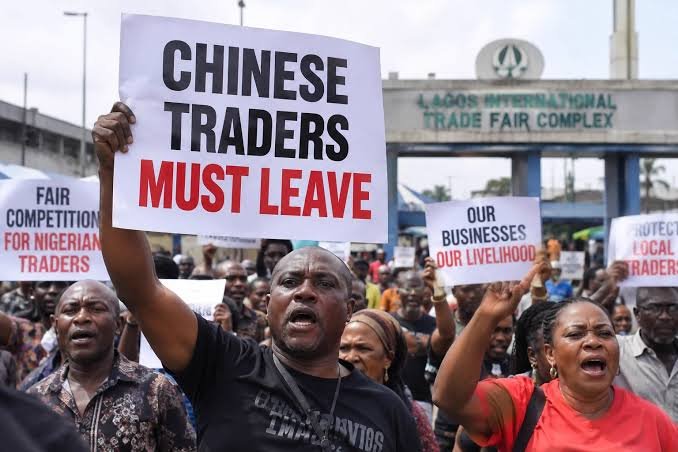
Something important is changing inside Nigeria’s trading economy, and the recent protest at the Lagos International Trade Fair Complex has exposed it.
For years, the arrangement was relatively straightforward. Chinese manufacturers produced the goods. Nigerian traders travelled to China, bought in bulk, imported the products, brought them into Nigeria and distributed them through the country’s markets.
That arrangement created an entire Nigerian business ecosystem around importing and distribution.
The trader was not merely selling a product. He was financing imports, taking the risks, clearing goods, paying rent and levies, moving merchandise around the country and building relationships with retailers and final consumers.
Now, some Nigerian traders at the Lagos Trade Fair Complex say that arrangement is being disrupted by Chinese businesses that are moving beyond wholesale supply and selling directly to consumers.
That is what triggered the recent protest at the complex.
The traders’ complaint that the people supplying them are increasingly becoming their competitors and that maybe a serious business problem.
A Nigerian trader importing goods from China may spend months waiting for shipments, pay for shipping and clearing, maintain a shop, employ workers and absorb other operating costs before making a profit.
If a Chinese supplier operating in the same market can access the same products directly from manufacturers and sell them to the final customer at a price close to, or even below the Nigerian trader’s buying price, the traditional retailer is immediately under pressure.
The trader cannot survive simply because he was there first. Business does not work that way.
But neither should the solution be to drive foreign businesses out of Nigeria simply because they have become competitive; that would miss the real issue.
The real issue is whether Nigeria has a clear and fairly enforced framework defining the boundaries between foreign manufacturing, wholesale distribution and retail trade.
The complaints at the Trade Fair Complex should therefore be treated as an economic policy issue, not an ethnic confrontation.
The fact that many of the protesting traders are Igbo is relevant to understanding the commercial community involved, but the underlying problem is bigger than the Igbo.
It concerns every Nigerian distributor whose business model depends on buying from a manufacturer or importer and selling to the next level of the market.
If the manufacturer decides to bypass the distributor, the distributor’s business model is immediately threatened and technology is making that disruption easier.
A manufacturer no longer needs to depend entirely on a chain of middlemen to reach consumers. Global supply chains, digital communication, direct ordering and increasingly efficient logistics are reducing the distance between production and the final buyer.
Nigeria cannot pretend that this transformation is not happening.
But there is another s of the argument that Nigerian traders must confront.
Consumers do not owe any trader a living.
If one seller offers the same product at a lower price, consumers will naturally look in that direction. That is not necessarily unfair competition. Sometimes it is simply competition.
The Nigerian trader cannot demand protection from competition while refusing to examine why his cost of doing business is so high.
If his imported product is expensive because of freight, port charges, customs procedures, financing costs, multiple levies, electricity, rent and transportation, the answer cannot always be to make the competitor more expensive.
Nigeria also has to ask why a foreign business can sometimes bring a product into the country and compete more aggressively on price than a Nigerian businessman who has been in the market for years.
That is where the conversation becomes uncomfortable, the problem may not simply be the Chinese trader, it may also be Nigeria’s business environment.
The country has spent decades building a trading economy around imported goods without developing enough competitive domestic manufacturing.
We import the finished product.
We complain about the importer.
We complain about the wholesaler.
We complain about the retailer.
But we rarely confront the underlying weakness; why are Nigerian businesses not producing enough of these goods competitively in the first place?
Until that changes, Nigerian traders will remain heavily exposed to the decisions of foreign manufacturers.
There is also a legitimate regulatory question.
If Nigerian law allows a foreign company to sell directly to consumers, then the government cannot simply invent a restriction because local traders are angry. If certain categories of retail activity are restricted or require specific permits, then those rules should be enforced consistently, whether the operator is Nigerian, Chinese, Lebanese, Indian or from anywhere else. That is what fair competition means.
The Lagos International Trade Fair Complex Management Board has already moved to address the dispute and stressed the need for a fair and lawful business environment. That is the direction the authorities should take.
There should be no room for intimidation, violence or xenophobic rhetoric.
But there should also be no room for regulatory double standards.
Foreign investors should be welcome in Nigeria.
Nigerian businesses should also be protected from unlawful or unfair practices.
Those two positions are not contradictory.
In fact, Nigeria needs foreign investment. Chinese companies have become important participants in Nigerian commerce, manufacturing and infrastructure. The country cannot simultaneously seek Chinese capital and treat every Chinese business operating in Nigeria as an enemy.
What Nigeria should demand is compliance, transparency and fair competition. And Nigerian traders must also adapt.
The days when simply travelling to China, importing a container and opening a shop automatically guaranteed a comfortable margin are disappearing.
The trader of tomorrow will need stronger purchasing networks, better logistics, digital marketing, better customer service, access to finance and, increasingly, direct relationships with manufacturers.
The answer to a more efficient competitor cannot always be protest, sometimes it has to be adaptation. But adaptation cannot solve a regulatory problem.
If Chinese wholesalers are legitimately operating as wholesalers, they should be able to do so. If they are crossing into activities restricted by Nigerian law or their approved business arrangements, regulators should act.
If there is no restriction, then Nigerian traders must compete, that distinction is critical.
Because the worst possible outcome would be to turn a genuine economic disagreement into an ethnic confrontation.
Nigeria has had enough experience with the damage that can follow when commercial competition is turned into hostility against a nationality or ethnic group.
The traders have a legitimate interest in protecting their businesses.
Chinese businesses have a legitimate interest in operating within Nigerian law.
And Nigerian consumers have a legitimate interest in finding quality goods at competitive prices.
Government’s job is to make sure these interests can coexist under clear rules.
The future of Nigerian commerce cannot be built by protecting yesterday’s middleman from every new competitor. But neither can it be built by allowing powerful suppliers to rewrite the market rules at the expense of local businesses.
Nigeria needs a trading environment where competition is real, rules are clear and everybody plays by them.
The Lagos dispute should therefore become a wake-up call, a real trade battle unfolding in Lagos.
Reloaded News — NEWS THAT INFORMS. MEDIA THAT TRANSFORMS