


Reloaded News International
PARIS — High school students across France have taken to the streets over worsening conditions in the country’s education system, with complaints ranging from teacher shortages and overcrowded classrooms to deteriorating school buildings, heavy workloads and anxiety over university admissions.
The protests, which began in the Paris region in late September, have spread nationwide and increasingly disrupted schools, universities and public transport.
More than 1,000 schools were affected on Thursday, according to French authorities, while about 400 schools were expected to remain closed on Friday as a precaution. University students have also joined the mobilisation, with around 30 campuses reportedly blocked.
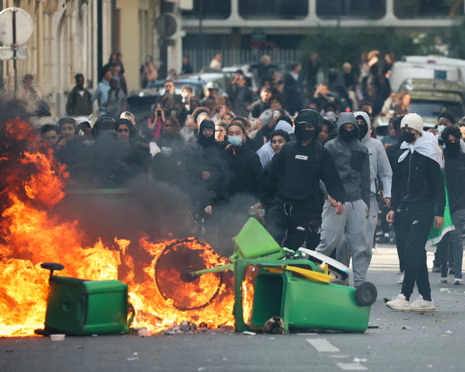
The demonstrations have also become increasingly confrontational, with fires, property damage and clashes with police reported in several cities.
What the students are demanding
According to Reloaded News’ source in France, teacher shortages are among the most persistent complaints.
Students say some classes are left without teachers when staff are absent and that replacement teachers are not always provided.
They are also protesting overcrowded classrooms, with some reporting classes of around 30 to 35 students.
Poor school infrastructure is another major concern. Students are demanding repairs and better facilities, including improvements to buildings affected by excessive heat.
Heavy timetables are also drawing criticism, with some students complaining about long school days and what they regard as excessive academic workloads.
The students are additionally calling for more support personnel, including school nurses and other staff who provide assistance within schools.
Another concern is Parcoursup, France’s system for applying to higher education. Students say the university application process adds to the pressure they already face during their final years of secondary school.
The grievances reported by the student movement broadly correspond with demands for more teachers, replacement staff, improved facilities and better learning conditions reported by French student organisations.
From school grievances to street clashes
The protests have not remained peaceful everywhere.
Authorities reported fires, damaged property and confrontations between protesters and police in several cities on Thursday.
In Marseille, firefighters responding to a school fire were reportedly surrounded by young people and forced to leave their vehicle, which was subsequently set alight. A headteacher at another school in the city was also attacked and injured, according to prosecutors.
A fire was also reported at a school in Nantes, while clashes and vandalism were reported in cities including Toulouse and Lille.
Police have used riot-control measures to disperse protesters in some locations.
Three investigations have also been opened following allegations of excessive police force against students, according to reports.
Nearly 2,000 arrested
The scale of the unrest increased sharply on Thursday.
France’s Interior Ministry reported 1,949 arrests, while authorities reported hundreds of injuries among police, students and education staff. The Education Ministry said 170 students and 65 education-sector employees had been injured.
The figures include people detained during the wider disturbances surrounding the school blockades and demonstrations.
The government has drawn a distinction between students exercising their right to protest and what it describes as violent actions involving some participants and other individuals.
Government holds crisis meeting
Prime Minister Sébastien Lecornu convened a crisis meeting of his government as the protests spread.
Ministers were asked to remain focused on the situation and coordinate with local authorities.
Education Minister Édouard Geffray is also scheduled to meet student, teacher and parent representatives to discuss the grievances behind the mobilisation.
The government has said schools may move classes online where necessary to protect students and staff.
Budget cuts add to the tension
The student protests are taking place against the backdrop of a wider dispute over France’s proposed 2027 budget.
The government has presented a programme of tax increases and spending reductions aimed at reducing the country’s budget deficit. Reuters reported that the plan includes measures intended to generate or save tens of billions of euros.
Public-sector workers have separately been protesting against the proposed spending reductions, creating an overlap between the students’ education concerns and a broader national debate over public spending.
For students, the concern is that reduced public investment could further affect schools already struggling with staffing, facilities and support services.
Political dispute grows
The demonstrations have also become politically contentious.
Government officials and some political opponents have accused the left-wing La France Insoumise (LFI) movement of encouraging or helping to drive the protests.
LFI has rejected that characterisation. Its leaders have said they support peaceful mobilisation while accusing the government of mishandling the situation.
Student organisations have likewise argued that their grievances are genuine and should not be dismissed as the product of political manipulation.
A protest about the future
At its core, the mobilisation began with a question about what students encounter every day in school; whether there are enough teachers, whether classrooms are suitable for learning, whether buildings are properly maintained and whether students have adequate support as they prepare for higher education and employment.
The escalation into violence has now created a second challenge for the French government, maintaining public order while responding to the underlying education complaints.
With the protests spreading across France and intersecting with the wider dispute over the 2027 budget, authorities face pressure on two fronts; restoring access to schools and addressing the conditions that brought students onto the streets in the first place.
NEWS THAT INFORMS, MEDIA THAT TRANSFORMS