
Obasa’s Agege Fortress Shaken; Defections Of Allies Open New 2027 Front

By Reloaded News Desk
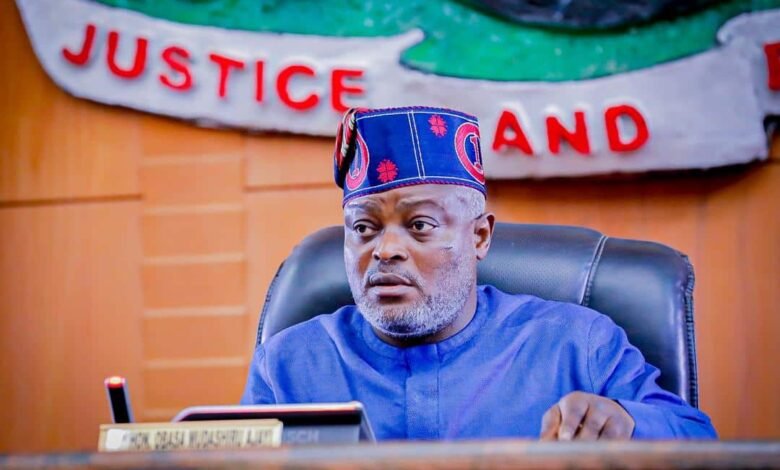
The political structure around Lagos State House of Assembly Speaker, Mudashiru Obasa, has come under fresh scrutiny following the defection of two politicians identified with his political camp from the All Progressives Congress to the Allied Peoples Movement ahead of the 2027 elections.
The development is significant because it involves Ganiyu Kola Egunjobi, immediate past chairman of Agege Local Government, and Azeez Oladapo Yusuf, popularly known as Ninolowo, who sought APC tickets for Agege Constituencies I and II respectively.
Both subsequently secured APM tickets after the APC recognised different candidates for the two constituencies.
The development has inevitably placed Obasa in the political spotlight.
But the facts require careful examination.
THE AGEGE BATTLE
Egunjobi and Yusuf were initially reported as winners of the APC primaries before the party subsequently recognised Gbenga Abiola for Agege Constituency I and Sakiru Enimakure for Constituency II.
Egunjobi challenged the revised outcome, maintaining that the announced result did not reflect what happened at the voting centres.
The dispute eventually produced a political rupture.
Both men moved to the APM and are now pursuing their 2027 ambitions outside the APC. The Lagos APC subsequently expelled them, accusing them of anti-party activities and disloyalty after they obtained tickets from another political platform.
But there is an important complication, Egunjobi and Yusuf have strongly denied that Obasa engineered their departure. They said their decision was independently taken after what they described as injustice in the APC primary process.
It means the current development cannot responsibly be presented as evidence that Obasa has lost control of his political allies. But neither should its political significance be dismissed.
Obasa’s influence in Agege is well established, and the two politicians involved have been publicly identified as his political associates.
Indeed, reports indicate that Obasa endorsed Egunjobi and Yusuf during an Agege stakeholders’ meeting in May, around the time he declared his own intention to contest the Agege Federal Constituency seat in the House of Representatives.
Their subsequent departure therefore creates an obvious political question; What does the development mean for Obasa’s political structure in Agege?
That question becomes more interesting because Obasa himself is transitioning from the Lagos Assembly to the federal contest. He secured the APC ticket for Agege Federal Constituency.
At the same time, two politicians associated with his political camp are leaving the APC after losing their Assembly tickets, that creates a new political equation in the constituency.
Obasa’s political story has already survived a major institutional crisis.
In January 2025, he was removed as Speaker by lawmakers and replaced by Mojisola Meranda. Obasa challenged the process in court.
In April 2025, the Lagos High Court declared his removal illegal, unconstitutional, null and void and also nullified the proceedings through which he had been removed.
He subsequently returned to the speakership.
That episode demonstrated both the vulnerability and resilience of his political position.
Now another test is emerging, not over the speakership, but over the political structure he will need as he seeks election to the House of Representatives.
It would be premature to describe the latest developments as the collapse of Obasa’s political structure.
There are competing interpretations.
The two defectors say they acted independently because of their disagreement with the APC primary process.
Some Agege APC stakeholders, meanwhile, have argued that their departure will not damage the party’s prospects and have pledged to mobilise behind the APC candidates.
The APC itself has treated the defections as a disciplinary matter rather than evidence of a broader political breakdown.
So far, the available evidence establishes a dispute over nomination, two defections and a subsequent party expulsion.
It does not establish that Obasa directed the defections or that his political influence in Agege has collapsed.
But politics is rarely judged only by what has already happened.
It is also about what the development reveals about the relationships and competing interests beneath the surface.
THE BIGGER 2027 QUESTION
The real significance of the Agege developments may therefore lie beyond the two Assembly seats.
Obasa is preparing to move from the Lagos Assembly to the National Assembly.
The question is whether he can successfully transfer the political influence he has accumulated around the Assembly and Agege into a new federal political platform.
The current dispute provides an early test.
Can his political network remain cohesive when individual ambitions collide with party nominations?
Can disagreements be resolved without producing defections?
Can the APC maintain unity in Agege?
And can Obasa’s political structure deliver the level of mobilisation required for the 2027 federal contest?
These questions remain open.
What is not in doubt is that Agege has entered another phase of political manoeuvring.
And because Agege is central to Obasa’s political identity, developments there will inevitably be watched as a measure of the strength, adaptability and cohesion of his political structure.
For now, the storm is not necessarily a political collapse, but it is certainly a storm worth watching.
The 2027 election may ultimately reveal whether the current turbulence was merely an internal disagreement over tickets or the beginning of a much larger realignment in Agege politics against the long domineering tendencies of Mr. Speaker.