
Constituents Blast Osun Reps Member; Oladebo of Ayedaade/Irewole/Isokan, Say He Lacks Ideas, Is Not Worthy to Be a Legislator, Does Not Deserve Another Term


By Reloaded News Desk
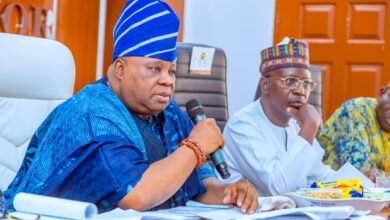
The presentation of a political scorecard by Hon. Lanre Omoleye Oladebo, member representing Ayedaade/Irewole/Isokan Federal Constituency in the House of Representatives under the Accord Party, has triggered strong criticism from some constituents, who have questioned the quality of his representation and expressed doubts about his suitability for another term in the National Assembly.
The controversy followed a video circulating on Facebook in which the lawmaker was seen addressing party members during a political gathering, reportedly seeking their support for a second term.
In the video, Oladebo disclosed that he had given ₦20,000 each to party unit chairmen and ₦30,000 each to ward executives. He also indicated that executives across the local government areas had received money.
The lawmaker further announced that he had brought more than ₦8 million to the gathering, presenting his activities and scorecard as part of the reasons he deserved another term.
However, the presentation has provoked criticism from some constituents, who argue that distributing money and other forms of assistance to party officials should not be confused with effective legislative representation.
Constituents Question His Understanding of Representation
One of the critics, Kabir Opeloyeru, described the situation as disheartening and embarrassing, questioning why political conversations in the constituency were still dominated by the distribution of rice, fertiliser and other forms of assistance in 2026.
He argued that the people should be demanding good governance, quality representation, infrastructure, job creation and sustainable development rather than allowing political engagement to revolve around the sharing of palliatives.
“How did we regress from demanding good governance, quality representation, infrastructure, job creation and sustainable development?” he queried.
Opeloyeru further questioned whether the expectations of the constituency had been reduced to receiving handouts from politicians, insisting that the people deserved better.
He also drew attention to the crowd’s reaction at the event, suggesting that the gathering itself raised questions about the reception of the lawmaker’s presentation.
In a direct criticism, he told Oladebo: “Chai Hon Lanre Oladebo, you can do better.”
Student Union Stakeholders Also Come Under Criticism
Another constituent, Moses Ejidokun, expressed disappointment over what he described as the enthusiastic praise given to the lawmaker by individuals regarded as stakeholders in student unions across the constituency.
He said it was particularly disturbing to see people expected to represent the interests of students celebrating the lawmaker’s presentation.
“The man has failed,” Ejidokun declared.
Another commenter, Memudu, described the situation as “very shameful.”
The reactions reflect dissatisfaction among these commentators over what they consider an inadequate standard of political accountability and representation.
Beyond ₦8 Million: Where Is the Legislative Scorecard?
The central question raised by the controversy is whether the distribution of money to party executives and the presentation of cash at a political gathering constitute sufficient evidence of legislative performance.
A representative’s scorecard should be assessed through measurable contributions to lawmaking, motions, bills sponsored or supported, participation in legislative debates, oversight responsibilities, constituency development initiatives and interventions capable of improving the lives of the people.
Political mobilisation and financial assistance to party members may have their place in party administration, but they cannot replace the constitutional responsibilities of an elected legislator.
The people of Ayedaade, Irewole and Isokan deserve to know what their representative has contributed to national legislation, what development opportunities he has attracted, what projects have been facilitated and how his interventions have addressed the challenges confronting the constituency.
The issue is not whether a lawmaker should support party members or assist constituents financially. Rather, it is whether such gestures are being presented as the principal evidence of a legislative record that should be judged by broader public outcomes.
A Bigger Question About Political Leadership Recruitment
Beyond the controversy surrounding Oladebo’s presentation, the development raises a more fundamental question about the quality of leadership recruitment within political parties.
Political parties occupy a critical position in Nigeria’s democratic process. They are the institutions responsible for identifying, screening, promoting and presenting individuals to the electorate as candidates for public office.
Consequently, the responsibility of a political party does not end with securing electoral victory for its candidates. It must also demonstrate seriousness in the quality, capacity, public orientation and preparedness of the individuals it presents to represent the people.
It is particularly troubling when the standard of political recruitment appears to place greater emphasis on financial capacity, party loyalty, mobilisation strength and the ability to distribute money than on legislative competence, ideas, policy understanding and a demonstrable commitment to public service.
It is a disservice to the electorate when a party presents a candidate whose public performance and understanding of representation are subsequently subjected to serious questions by constituents.
For the Accord Party, which now provides the political platform for Oladebo, the conversation should extend beyond electoral calculations to the responsibility of presenting candidates capable of meeting the expectations of the people.
It is wicked to the electorate for any political party to treat the process of selecting candidates for public office as an exercise in political convenience while overlooking the competence and capacity required to discharge the responsibilities of such offices.
The electorate should not be expected to bear the consequences of poor political recruitment after candidates have been presented to them for elections.
Constituents Deserve More Than Political Handouts
The reactions to Oladebo’s video have brought attention to a broader democratic concern: the need to move constituency politics away from the politics of handouts and towards measurable development and accountability.
Representatives must be prepared to defend their records with facts, explain their legislative contributions and demonstrate how their time in public office has translated into meaningful improvements in the lives of their constituents.
As political activities ahead of the next election cycle gather momentum, the people of Ayedaade/Irewole/Isokan Federal Constituency have a right to demand answers.
The most important question is no longer how much money a lawmaker brought to a political gathering or how much was distributed among party officials.
It is what the people have gained from his representation.
The electorate deserves legislators with ideas, capacity, vision and a clear understanding of public service—not merely political figures whose scorecards are dominated by cash distributions.
Reloaded News — NEWS THAT INFORMS. MEDIA THAT TRANSFORMS.