
Osun’s ₦5.5 Billion Cash Discrepancy, ₦206.9 Million Heritage Bank Exposure: Auditor-General Raises Questions Over Adeleke Government’s Financial Records.

By Reloaded News
The financial records of the Osun State Government have come under fresh scrutiny following revelations in the 2025 report of the State Auditor-General, which questioned the accuracy of the government’s bank balances and raised concerns over ₦206,939,439.58 associated with the defunct Heritage Bank.
The report, issued by the Auditor-General, Kolapo Idris, contains findings that raise important questions about how public funds are kept, recorded and monitored by the state government.
One of the strongest observations in the report concerns the government’s declared cash position. The Auditor-General reportedly stated that the cash position presented in the state’s financial records “can never be correct” because of differences between the figures submitted by government agencies and the balances independently obtained from banks during the audit.
In simple terms, the government reported one amount as the money it had in its accounts, but the figures obtained directly from the banks did not agree with the amount in the government’s records.
₦5.5 Billion Difference in Bank Balances
According to the report, the financial statements showed that the state’s headquarters accounts had a balance of ₦18.54 billion.
However, figures obtained directly from the banks during the audit put the balance at approximately ₦24.06 billion.
The difference is ₦5.51 billion.
This means that the government records and the figures confirmed by the banks did not agree on the amount held in those accounts.
The Auditor-General reportedly expressed concern that some balances included in the financial statements were not supported by the hard-copy records submitted by the Office of the Accountant-General.
He also questioned the level of control exercised by the Accountant-General’s office over accounts operated by ministries, departments and agencies.
The difference does not, by itself, establish that ₦5.51 billion has been stolen or gone missing. It does, however, mean that the government must provide a proper reconciliation showing why the figures differ and what adjustments, if any, were made.
₦206.9 Million Associated With Defunct Heritage Bank
Another important issue concerns ₦206,939,439.58 recorded as money belonging to Osun State and associated with Heritage Bank.
The Central Bank of Nigeria revoked Heritage Bank’s operating licence on June 3, 2024, following concerns about the bank’s financial condition. The Nigeria Deposit Insurance Corporation subsequently took over the liquidation process.
The Auditor-General’s report raised questions about the status of the state’s money in the failed bank, including whether the government had recovered the funds or received any payment through the liquidation process.
For ordinary residents, the question is straightforward: what has happened to the state’s ₦206.9 million?
Has any part of the money been recovered? How much remains outstanding? Has the government properly reflected the money as a claim against the failed bank rather than as cash readily available for public spending?
These are questions the state government should answer.
It is important to note that the existence of a balance in a failed bank does not automatically mean the entire amount has been permanently lost. The NDIC has a process for settling eligible claims and distributing recoveries from the bank’s assets. However, the government must provide an update on the status of its particular claim.
₦2.46 Billion in Agency Accounts Not Returned to the Treasury
The Auditor-General also questioned why ₦2,461,228,654.96 held in accounts operated by ministries, departments and agencies had not been transferred to the state treasury as required by a government treasury circular.
The state government’s explanation was that the money formed part of sub-accounts under its modulated Treasury Single Account arrangement.
The Treasury Single Account is a system designed to give government better control over public funds by bringing its accounts under a coordinated treasury arrangement.
The issue raised by the audit is whether the agencies’ handling of these balances complied with the applicable financial rules and whether the money was properly accounted for.
The government should explain why the funds remained in those accounts and demonstrate that the arrangement complied with the relevant regulations.
Other Government Accounts Also Raised Concerns
The report identified other sums held in accounts described as dormant, inactive or restricted.
These included approximately ₦112.63 million in dormant accounts, ₦65.25 million in an inactive account and ₦11.31 million in restricted accounts.
The Auditor-General also raised concerns about some government bank accounts that still carried the names of retired public officers and a former commissioner as authorised signatories.
A bank signatory is a person officially authorised to approve or carry out transactions on an account. When a public officer retires or leaves government service, the relevant bank records should be updated to reflect the officials currently responsible for the account.
Leaving outdated names on government accounts raises questions about the effectiveness of financial supervision and the protection of public funds.
The report further stated that operational cash books for the accounts were not made available to the Auditor-General during the audit.
Cash books are records showing the money received, payments made and balances remaining in an account. They help auditors establish whether government transactions have been properly recorded.
₦963 Million Difference in VAT Figures
Another issue identified in the report concerns Value Added Tax figures for September 2025.
The state’s financial statements reportedly recorded VAT revenue of ₦10.78 billion, while the corresponding Federation Account figure was approximately ₦9.81 billion.
This produced a difference of about ₦963.08 million.
The state government’s explanation was that the difference represented additional revenue received during the month. However, the Auditor-General’s observation makes it necessary for the relevant figures and supporting records to be properly reconciled.
Questions Over the Auditor-General’s Final Opinion
The report also raises a question about the relationship between the Auditor-General’s strong observations on the state’s cash records and the unqualified opinion issued on the 2025 financial statements.
An unqualified opinion generally means that the financial statements are considered to present a true and fair picture of the government’s financial position under the applicable accounting rules.
It does not necessarily mean that every individual account or transaction is free from error.
Nevertheless, when the same report identifies substantial differences between the government’s declared bank balances and figures obtained independently from banks, the public deserves to understand how those issues were addressed before the financial statements were certified.
The authorities should explain whether the discrepancies were reconciled, whether corrections were made and how the final figures were established.
Government Must Explain the Figures
The findings in the Auditor-General’s report go beyond the ₦206.9 million associated with Heritage Bank. They raise broader questions about the accuracy of Osun State’s financial records, the supervision of government bank accounts and the management of public funds.
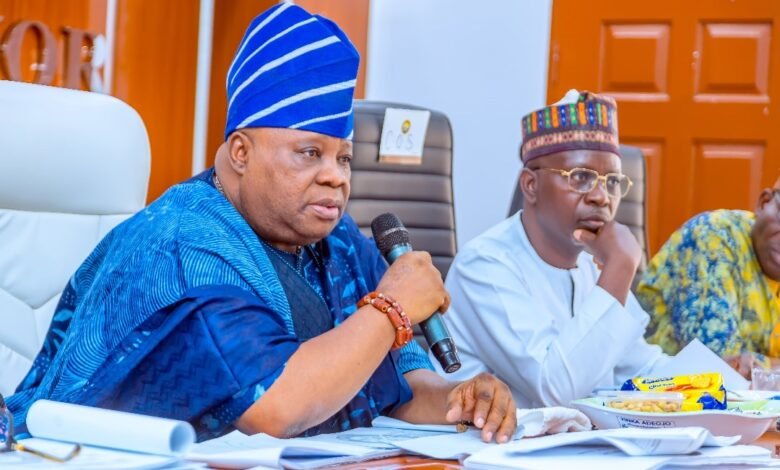
Governor Ademola Adeleke’s administration should provide clear explanations on the ₦5.51 billion difference in the headquarters bank balances, the status of the Heritage Bank money, the ₦2.46 billion held in agency accounts and the other discrepancies identified by the Auditor-General.
The Office of the Accountant-General should also explain the processes used to collect, verify and reconcile the financial information submitted by ministries, departments and agencies.
Public money belongs to the people, and government has a duty to account for every amount under its control.
For residents of Osun State, the issue is not simply about accounting language or figures in an official report. It is about knowing how much money the state has, where that money is kept and whether the financial records presented to the public can be trusted.
The Auditor-General’s findings have raised important questions. The responsibility now lies with the state government to provide clear answers supported by verifiable records.
Reloaded News — NEWS THAT INFORMS. MEDIA THAT TRANSFORMS