

By Reloaded News Desk
AKURE — Oyo State Governor and presidential candidate of the Allied Peoples’ Movement (APM), Seyi Makinde, has unveiled his “Reset Nigeria” agenda, calling for changes to Nigeria’s economy, education system, security architecture and political environment ahead of the 2027 general election.
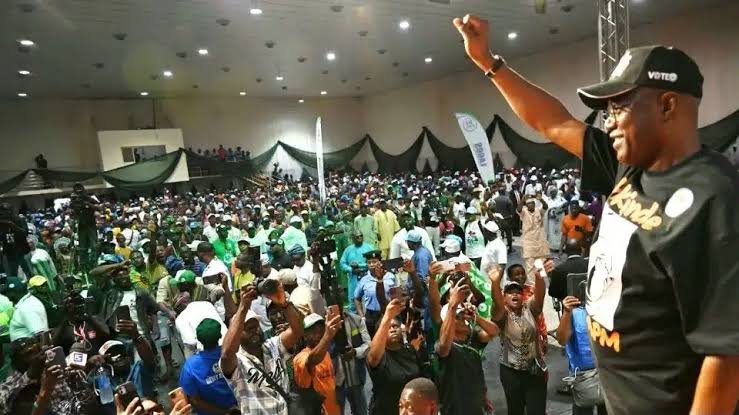
Makinde presented the agenda on Thursday at the APM South-West Town Hall Meeting held at the Ondo State International Conference Centre, The Dome, in Akure, where party leaders, campaign officials and political stakeholders from across the region gathered to discuss the party’s presidential campaign.
The governor urged the South-West to take an active role in shaping Nigeria’s political and economic future, arguing that leadership should be determined by competence and capacity rather than political entitlement or assumptions about which region should produce the next president.
“We want to reset Nigeria. Southwest Zone of Nigeria, we are very much ready to reset Nigeria. I am a reset agent,” Makinde said.
He urged supporters to obtain their Permanent Voter Cards (PVCs) and mobilise voters across the country, describing them as “Reset Agents” who would take the campaign’s message to communities and households.
Makinde rejects ‘turn-by-turn’ leadership
The APM presidential candidate criticised what he described as “turn-by-turn” politics, arguing that the distribution of political power and public projects should not be driven by regional entitlement or the personal interests of those in government.
He maintained that no part of the country should be excluded from national development because of the geographical origin of the president or the political affiliation of its residents.
Makinde also rejected the argument that the South-West should refrain from presenting another presidential candidate because President Bola Tinubu, the incumbent, is from the region.
Citing the 1999 presidential election, he recalled that former President Olusegun Obasanjo and Chief Olu Falae, both from the South-West, contested the presidency in the same election.
“Both were from the South-West, and heaven did not fall,” he said, arguing that voters should be allowed to assess candidates on their individual merits.
He urged Nigerians to prioritise leadership capacity, energy and readiness to serve when deciding who should lead the country from 2027.
Four pillars of the Reset Nigeria agenda
Makinde identified four principal areas of intervention under his proposed agenda: education, economic development, security and the socio-political environment.
On education, he argued that natural resources alone could not guarantee prosperity without a skilled and knowledgeable population. He said investment in human capital would be necessary to improve productivity and create opportunities for Nigerians.
On the economy, the governor called for a productive economic system in which infrastructure supports commercial activity and taxation promotes prosperity rather than deepening hardship.
He also questioned the Federal Government’s budget management, contrasting the national budget process with Oyo State’s January-to-December fiscal cycle.
Makinde said budget performance in Oyo had risen from approximately 28 to 30 per cent before he assumed office to more than 70 per cent under his administration, describing the improvement as a result of sustained fiscal management.
On security, he called for a stronger national security architecture that would enable businesses to operate and citizens to move freely without the fear of attacks.
He argued that insecurity should not force economic activities to shut down early or prevent communities from benefiting fully from their commercial and agricultural potential.
The fourth pillar, socio-political reform, focused on federalism, democratic participation and the protection of opposition parties.
Makinde warned against what he described as attempts to create crises within opposition parties, insisting that a functioning multiparty system was essential to democracy.
“Stop using the back door to cause crises for opposition parties. There is no democracy if we have a one-party system,” he said.
APM leaders rally behind Makinde
The party’s National Chairman, Yusuf Mamman Dantalle, called for collective action to address economic hardship, insecurity and concerns about accountability in government.
Dantalle argued that Nigeria’s natural and human resources should translate into better living conditions for citizens, questioning why many households continued to struggle with rising prices and declining purchasing power.
He also stressed that democracy should extend beyond the conduct of elections to include respect for voters’ choices and accountability from elected officials.
The APM’s National Leader and Bauchi State Governor, Senator Bala Abdulkadir Mohammed, expressed confidence in the party’s campaign and urged members to remain committed to its national renewal agenda.
Mohammed said the party intended to reduce hardship and restore public confidence in government, while cautioning members against distractions during the campaign.
The APM vice-presidential candidate, Alhaji Lawal Musa Daura, also called for unity and sustained mobilisation, saying the campaign aimed to address the country’s challenges and rebuild confidence in public institutions.
Former Osun State Governor, Prince Olagunsoye Oyinlola, and other speakers urged Nigerians, particularly young people, to support leadership they considered capable of advancing national development and protecting democratic institutions.
Other attendees included Oyo State Deputy Governor Bayo Lawal and Speaker of the Oyo State House of Assembly Adebo Ogundoyin, alongside political stakeholders and campaign representatives from the South-West.
APM faces the challenge of turning its agenda into a national campaign
The Akure meeting forms part of the Makinde-Daura presidential campaign organisation’s consultations and mobilisation activities ahead of the 2027 elections.
By presenting a policy-based message around education, the economy, security and democratic governance, the APM is seeking to position itself as an alternative to the established political parties.
However, the challenge before the party will be to translate its proposals into detailed policy commitments, expand its structures beyond its current political base and persuade voters that its programme can deliver measurable improvements in their daily lives.
Makinde’s presidential ambition also places him in a contest in which the South-West is already represented by the incumbent president. His argument is that regional origin should not prevent Nigerians from considering another candidate from the same zone.
The Akure meeting therefore served not only as a presentation of the APM’s policy priorities but also as an appeal for greater political participation and a defence of the party’s right to compete in the 2027 election.
Whether the “Reset Nigeria” message gains broader acceptance will depend on the campaign’s ability to explain how its proposals would be funded, implemented and measured across the country.
Reloaded News; News That Informs, Media That Transforms