

A Billionaire’s Heir, a Hollywood Wedding and the Question of Cultural Inheritance

By Reloaded News Desk
When a 34-year-old son of a Nigerian billionaire marries a 49-year-old divorced woman in Hawaii, with her former husband officiating the ceremony, the event is bound to attract attention. But beyond the celebrity headlines and photographs, the story raises a more difficult question about wealth, family values and cultural identity.
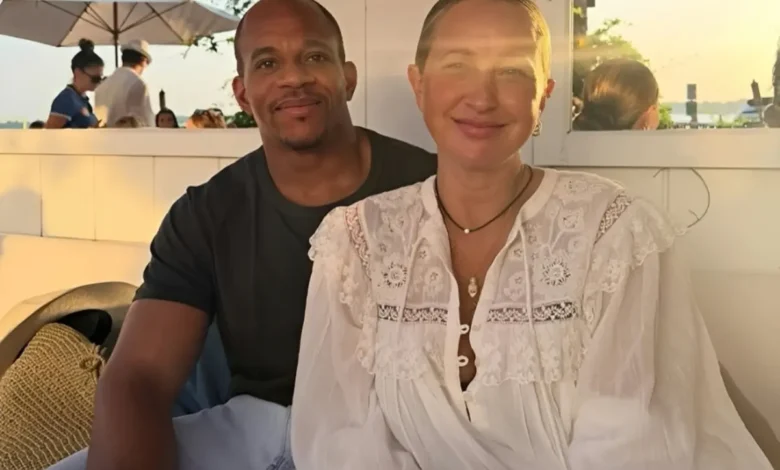
Geoffrey “Geoff” Ogunlesi, son of Nigerian billionaire Adebayo Ogunlesi, married American jewellery designer Jennifer Meyer on October 10, 2026, at the Four Seasons Resort Lanai in Hawaii.
Meyer’s former husband, Hollywood actor Tobey Maguire, officiated the ceremony. The wedding took place just nine days after their divorce was finalised on October 1.
Meyer and Maguire married in 2007, announced their separation in 2016 and maintained a relationship that allowed them to continue raising their children together. Meyer and Ogunlesi, who became engaged in 2024, also have a daughter together.
The ceremony was an unconventional arrangement by many people’s standards. Yet it is the cultural questions surrounding the marriage, rather than the celebrity names involved, that deserve closer examination.
When wealth meets cultural identity
Adebayo Ogunlesi is one of Nigeria’s most prominent internationally successful business figures. His career demonstrates the possibilities of global education, professional achievement and participation in international business.]
But financial success and cultural continuity are two different things.
A family can build extraordinary wealth across generations and still face difficult questions about the values, traditions and responsibilities it wishes to preserve. Money can be invested, companies can be expanded and assets can be transferred. Cultural identity, however, depends on what families teach, practise and pass on.
For many Yoruba families, marriage has traditionally involved more than the preferences of two individuals. It can bring together families, establish relationships between households and carry expectations about age, respect, ancestry and the continuity of family traditions.
These expectations vary between families and generations. They are not followed uniformly, even among Yoruba people, and there is no single model that defines every successful Yoruba marriage.
Nevertheless, the question remains relevant: as wealthy Nigerian families become increasingly international in their outlook, how much importance do they attach to the cultural values with which they were raised?
The question is not whether a Nigerian must marry within a particular ethnic group or whether every family should reject Western influences. Cultural exchange is not inherently a threat to identity.
The concern is whether global exposure enriches a person’s understanding of their heritage or gradually makes that heritage irrelevant to their choices.
Is financial inheritance enough?
The Ogunlesi wedding also invites reflection on what it means to inherit a wealthy family legacy.
A business empire is not preserved by money alone. Its continuity may depend on financial discipline, sound judgment, governance, responsible succession planning and the ability of the next generation to manage the responsibilities that come with wealth.
Families that wish to preserve a legacy must consider what they want their children to inherit beyond financial assets: their principles, sense of responsibility, family history and understanding of the work required to sustain what previous generations built.
This is where parenting and succession planning become important.
Parents can provide excellent education, financial opportunities and access to influential networks. They can also communicate the values that shaped their own lives. But children eventually make independent decisions, and those decisions cannot automatically be treated as evidence of parental failure.
There is no public evidence establishing that Adebayo Ogunlesi failed to raise his son properly, nor is there evidence that this marriage threatens the family fortune.
Those conclusions would go beyond what the available facts establish.
Still, the broader question is legitimate: how do families with substantial wealth prepare their children to preserve both their assets and the principles they consider important?
The uncomfortable question of cultural preservation
There is a temptation to treat every unconventional marriage involving a Nigerian abroad as proof that African culture is disappearing. That would be an oversimplification.
A 34-year-old man marrying a 49-year-old woman is not, by itself, proof that either person has abandoned their culture. A woman’s previous marriage does not diminish her worth, and an amicable relationship between former spouses does not necessarily indicate a failure to respect marital boundaries.
Indeed, Maguire’s participation may reflect the close relationship he and Meyer have maintained while raising their children.
The more useful question is whether families are consciously deciding which traditions they wish to preserve and which expectations should evolve.
Culture is not merely the clothing people wear at ceremonies, the language they speak at home or the food served at family gatherings. It also includes the principles through which communities understand marriage, family obligations, respect and the transmission of responsibility between generations.
Some traditions deserve preservation. Others may require reconsideration. The challenge is to make those decisions thoughtfully rather than assume that everything foreign is superior or everything traditional is beyond criticism.
For Nigerian families living abroad, that responsibility can be particularly complex. Their children may grow up in societies with different social expectations, legal systems and ideas about relationships. Maintaining cultural connections in those circumstances requires more than appeals to ancestry; it requires sustained engagement with the next generation.
What should the conversation really be about?
The wedding in Hawaii is a private family event involving adults who are entitled to make their own choices. Its unusual circumstances may invite public curiosity, but they do not provide sufficient grounds to condemn the people involved.
What the story does offer is an opportunity to discuss a larger issue facing wealthy families everywhere: what, precisely, constitutes a legacy?
If legacy means only money, property, investments and corporate influence, then financial succession may be enough to satisfy that definition.
But if legacy also means cultural identity, family responsibility and a shared understanding of where a family comes from, the conversation becomes more complicated.
The responsibility for passing on those values begins at home. It cannot be delegated entirely to schools, religious institutions or the wider community. Yet neither can parents dictate every adult decision their children will make.
The balance lies in raising children who understand their heritage, can explain the values they have inherited and are capable of making independent choices without losing sight of their identity.
For Nigeria’s wealthy and influential families, this is a conversation worth having. It should not be limited to one marriage, one family or one public figure.
The ultimate question is not whether a billionaire’s son has married according to public expectations. It is whether the next generation of successful Nigerians can navigate a global world while retaining a meaningful connection to their cultural roots.
Wealth may provide the means to build an empire. Whether that empire survives across generations depends on far more than the money left behind.
Reloaded News — NEWS THAT INFORMS. MEDIA THAT TRANSFORMS.