


By Reloaded News Desk
How parents communicate with their babies may play an important role in language development, with research showing that responsive conversations and frequent exchanges can help infants develop early communication skills.
A study published in the Proceedings of the National Academy of Sciences (PNAS) found that parents who received coaching on how to communicate with their infants increased their use of infant-directed speech and engaged in more conversational turns with their children. These changes were associated with stronger language development.
The study, titled Parent Coaching Increases Conversational Turns and Advances Infant Language Development, was conducted by researchers Naja Ferjan Ramírez, Sarah Roseberry Lytle and Patricia K. Kuhl.
The researchers randomly assigned 71 families with six-month-old infants to either a parent-coaching group or a control group. The intervention included coaching sessions when the babies were six, 10 and 14 months old.
Researchers recorded the families’ home language environments at six, 10, 14 and 18 months to examine changes in parental speech, parent-infant interactions and children’s vocal development.
The results showed that parents who received coaching increased their use of infant-directed speech and engaged in more back-and-forth exchanges with their babies. Their children also produced more speech-related vocalisations and more words by 18 months than children in the control group.
The researchers found that increases in parental use of infant-directed speech and conversational turns were positively associated with children’s language growth.
Why conversations matter before babies can speak
Infants do not need to produce recognisable words before they can participate in early communication.
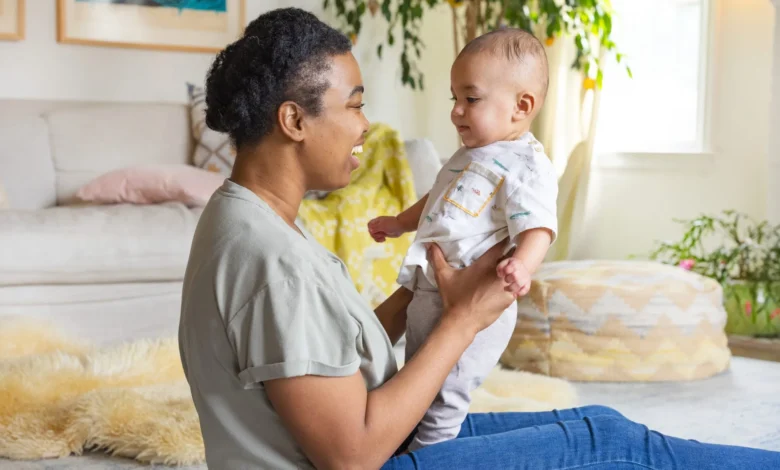
A baby may respond to a parent’s voice with eye contact, facial expressions, cooing, babbling or body movements. When a parent responds to these signals, the exchange creates an early form of conversation.
Researchers describe this process as conversational turn-taking, in which a parent speaks, the infant responds in a developmentally appropriate way, and the parent reacts to that response.
Harvard University’s Center on the Developing Child describes similar exchanges as “serve and return” interactions. These responsive exchanges help build the foundations for early language, social skills and healthy brain development.
The approach encourages parents and caregivers to notice a baby’s signals, respond to them, name the things the baby is looking at and allow time for another response.
How parents can encourage language development
The research offers practical lessons for parents, including those caring for newborns and young infants.
Talk during everyday activities. Parents can speak to their babies while feeding, bathing, changing nappies or dressing them. Simple descriptions of what is happening expose infants to the sounds and patterns of language.
Respond to the baby’s sounds. When a baby coos or babbles, parents can answer warmly, imitate the sound or add a few simple words. This encourages the rhythm of back-and-forth communication.
Use expressive, clear speech. Infant-directed speech, sometimes called parentese, often involves a slightly higher pitch, slower delivery and exaggerated intonation. Research suggests that this style can attract infants’ attention and support language learning.
Name familiar objects and actions. Parents can name a baby’s hands, feet, toys, clothes or other objects the child is observing. Repeating words in meaningful situations helps connect sounds with the surrounding world.
Allow time for a response. Parents should pause after speaking rather than treating communication as a one-way exercise. Babies need time to process sounds and respond in their own way.
Sing and read aloud. Songs, nursery rhymes, picture books and familiar stories provide opportunities to hear repeated words, rhythms and speech patterns.
Parents do not need to speak only English
In multilingual households, parents can communicate with babies in the languages they know best, including their mother tongue.
Speaking Yoruba, Igbo, Hausa, Nigerian Pidgin or another familiar language can provide meaningful opportunities for interaction. The central principle is responsive communication, not forcing a particular language or making every exchange resemble a classroom lesson.
Parents should also understand that language development varies among children. Talking frequently does not guarantee a particular developmental outcome, and the absence of early words does not, by itself, establish a developmental problem.
If a child is not responding to sounds, appears to have difficulty hearing or shows concerns about communication milestones, parents should discuss those concerns with a qualified healthcare professional.
Quality of interaction matters
The findings reinforce the importance of parents being actively engaged in their babies’ early communication.
Rather than focusing only on how many words a child hears, parents can create opportunities for interaction by listening to their babies’ signals, responding appropriately and allowing exchanges to continue naturally.
The researchers’ findings suggest that parent coaching can improve the way adults communicate with infants, with potential benefits for children’s early language development.
For parents, the practical message is straightforward: everyday moments spent talking, listening, responding and sharing attention can help lay the groundwork for a child’s communication skills.
Reloaded News; News That Informs, Media That Transforms