

By Reloaded News Desk
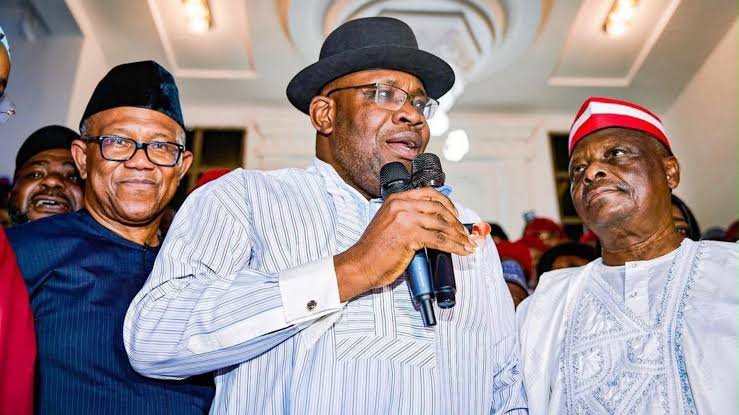
The internal disagreements surrounding the National Democratic Congress (NDC)’s presidential campaign arrangements have raised questions about the party’s preparedness for the 2027 general election, following a dispute over campaign structures and fresh allegations of tension between its presidential candidate, Peter Obi, and National Leader Seriake Dickson.
The latest controversy emerged after the party postponed the inauguration of its National Campaign Council, initially scheduled for October 20, 2026, to October 26. The party attributed the postponement to Obi’s overseas engagement.
However, a report alleged that the postponement followed a disagreement between Obi and Dickson over the composition of the campaign council and the management of campaign funds.
The report cited unnamed sources who claimed that Dickson rejected some of Obi’s proposed nominees, including social media influencers and content creators, while insisting that the presidential campaign council should operate within the party’s institutional framework.
The alleged confrontation, including claims that Obi stormed out of a meeting and felt humiliated, has not been independently corroborated. Neither has the claim that the presidential candidate’s overseas trip was prompted by the disagreement.
Nevertheless, the allegations have drawn attention to an important question facing the party: how will the NDC reconcile the political authority of its presidential candidate with the institutional control exercised by its leadership?
Campaign structures and competing centres of authority
The latest allegations follow an earlier public disagreement over the OK Movement, a political support group associated with Obi and Rabiu Kwankwaso’s supporters.
In September, the movement announced a 59-member presidential campaign council. The NDC subsequently rejected the parallel arrangement, reinforcing its position that campaign structures must operate within the party’s recognised framework.
The disagreement exposed a potential tension between grassroots political mobilisation and the authority of the party leadership.
Obi and Kwankwaso command support networks that extend beyond the party’s formal membership. Such networks can provide mobilisation capacity, volunteers and digital communication. However, their activities must be coordinated with the official campaign structure if the party is to maintain clear lines of responsibility.
The NDC later announced that Obi and Kwankwaso could nominate candidates for key campaign positions, including Director-General, Head of New Media, campaign spokesperson and finance officers.
That arrangement suggests that the party had attempted to establish a framework for balancing candidate input with institutional oversight.
What remains unclear is whether the latest reported disagreement concerned the implementation of that arrangement, the suitability of particular nominees or a broader struggle over who would exercise final authority.
The financial dimension of the controversy carries particular significance because of the disputes that emerged within the Labour Party following the 2023 presidential election.
In February 2024, Labour Party National Treasurer Oluchi Opara accused then-national chairman Julius Abure of failing to account for approximately ₦3.5 billion. The party disputed her allegations, challenged her account of its finances and suspended her.
Obi subsequently called for an independent audit and reconciliation of the party’s accounts.
A separate controversy emerged over the distinction between money received by the Labour Party and donations managed by Obi’s presidential campaign organisation.
In September 2024, Abure argued that Obi’s campaign funds had been managed outside the party’s financial structure. Aisha Yesufu, who was involved in the campaign’s fundraising arrangements, disputed aspects of the party chairman’s account and maintained that the campaign and party operated separate donation arrangements.
The competing claims highlighted a fundamental governance question: when a presidential candidate raises funds through a campaign organisation, what responsibility does the political party have for receiving, supervising and accounting for that money?
The available public accounts do not establish that every allegation made during the Labour Party dispute was proved. However, the controversy demonstrated the difficulties that can arise when the boundaries between party finances, campaign donations and support-group activities are unclear.
The NDC’s reported insistence on a dedicated campaign account and financial oversight involving designated officers and the party’s National Treasurer therefore raises an important institutional question.
Such controls can promote accountability, but the party must also communicate clearly how fundraising authority, spending approvals and reporting responsibilities will operate in practice.
The challenge of managing the Obi-Kwankwaso ticket
The wider concern is whether the NDC can establish a coherent command structure before the presidential campaign intensifies.
A presidential ticket involving two nationally recognised politicians requires coordination among the party leadership, campaign management, financial officers, grassroots organisations and digital mobilisation teams.
Disagreements over appointments can become more consequential when they are perceived as contests over influence rather than questions of competence, responsibility or campaign strategy.
Similarly, financial oversight must be sufficiently transparent to prevent misunderstandings over who controls donations and authorises expenditure.
The NDC’s position that it must operate as an institution rather than as a vehicle controlled by an individual candidate reflects a legitimate organisational concern. At the same time, a presidential candidate needs a clearly defined role in assembling and directing the campaign team responsible for presenting the ticket to voters.
The challenge is to reconcile those responsibilities without creating parallel structures, competing chains of command or uncertainty over financial accountability.
The party’s earlier disagreement with the OK Movement makes these questions more pressing.
Questions the NDC must answer
The postponement of the campaign council inauguration gives the party an opportunity to clarify the arrangements before the next stage of its campaign.
First, what procedure governs the nomination and approval of campaign council members, and can either the party leadership or the presidential candidate reject nominees without consultation?
Second, how are donations raised directly by the candidates to be distinguished from funds received by the party or its support groups?
Third, who will authorise campaign expenditure, reconcile accounts and ensure compliance with applicable electoral and financial reporting requirements?
Finally, has the party’s leadership resolved the reported disagreements, and will the October 26 inauguration proceed as rescheduled?
Clear answers would help distinguish routine organisational disagreements from a more fundamental conflict over the authority to direct the campaign.
A test of institutional preparedness
The NDC’s immediate challenge is not simply to inaugurate a campaign council. It is to demonstrate that its leadership and presidential ticket can operate within a common structure with clearly defined responsibilities.
For a party seeking to contest the presidency in 2027, prolonged uncertainty over appointments, fundraising and decision-making could undermine public confidence in its ability to coordinate a national campaign.
Whether the reported tensions reflect a serious internal breakdown or disagreements that can be resolved through established procedures remains to be seen.
What is clear is that the NDC must settle the questions of campaign authority and financial accountability before they overshadow its preparations for the election.
Reloaded News — NEWS THAT INFORMS. MEDIA THAT TRANSFORMS.