

By Reloaded News Desk
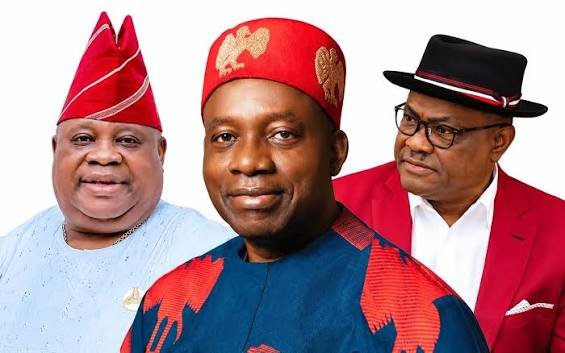
The inclusion of Nyesom Wike, Ademola Adeleke and Chukwuma Soludo in President Bola Tinubu’s 2027 Presidential Campaign Council has turned an otherwise familiar campaign inauguration into a more complicated political development.
The three men occupy different positions in Nigeria’s political system. Wike is the Minister of the Federal Capital Territory and a member of the Peoples Democratic Party (PDP). Adeleke governs Osun State under the Accord Party, while Soludo is the governor of Anambra State and a member of the All Progressives Grand Alliance (APGA).
Their participation in the APC-led campaign structure does not mean that their parties have merged with the ruling party. It does, however, demonstrate that Tinubu’s re-election effort is drawing support from political figures whose influence is not confined to the APC.
The central question is what that support means in practical terms. Does it represent a coalition capable of coordinating political interests across party lines, or does it principally formalise relationships that already existed?
The answer will depend on what happens beyond the campaign council’s inauguration.
Wike’s position is the most distinct because his support for Tinubu has developed alongside his continued association with the PDP.
His participation in the campaign council formalises a political alignment that has been visible since the 2023 election cycle, when his disagreements with the PDP’s presidential leadership placed him at odds with sections of his party.
As FCT minister, Wike is also a member of the federal executive under Tinubu. His political role in the President’s re-election campaign therefore sits alongside his government responsibilities and his relationship with the PDP.
His assignment to coordinate the campaign in Rivers State and the FCT gives him a defined role in the national mobilisation structure. Whether that role produces wider support will depend on the cooperation of local political actors and the willingness of voters to follow his lead.
The Osun governor won the August 2026 governorship election under the Accord Party, yet he has also expressed support for Tinubu’s re-election. His inclusion in the APC campaign council places him in a cross-party arrangement that could have implications for relationships within Osun’s political landscape.
Adeleke’s position raises questions about how presidential campaigning will interact with his own party’s interests, the political relationships supporting his administration and the expectations of voters who elected him under a different platform.
Soludo’s involvement has a separate context. He has previously expressed support for Tinubu’s second term and said APGA would not field a presidential candidate in 2027. His inclusion in the campaign council therefore builds on a position he had articulated before the inauguration.
In those contexts, treating all three appointments as evidence of a single political realignment would overlook the different histories and interests behind their participation.
What the APC Stands to Gain
The APC’s expanded campaign structure gives Tinubu access to political relationships beyond the party’s formal membership.
Governors and influential political figures can provide local knowledge, networks of political associates and access to communities where the ruling party may need additional support. Their participation may also help the campaign engage political constituencies that do not identify primarily with the APC.
But influence is not the same as electoral control.
A governor’s support for a presidential candidate does not establish that every member of the governor’s party, every local political leader or every voter in the state will support that candidate.
Nor does an appointment automatically resolve disagreements between local political organisations. Political alliances often involve competing interests, and those interests can become more visible as the election approaches.
For the APC, the task is to turn individual endorsements into coordinated political activity without assuming that support at the top guarantees acceptance at the grassroots.
That requires more than announcing appointments. The campaign must demonstrate how its coordinators will work with local organisations, mobilise eligible voters and communicate the administration’s record.
The results will become clearer through actual campaign activity, not the size of the council.
The Electoral Test: Can Political Endorsements Deliver Votes?
The most revealing element of Tinubu’s inauguration address was his warning that previous victories would not count as completed assignments unless members delivered votes in their electoral wards.
That instruction acknowledges a distinction at the heart of election campaigning: political prominence does not automatically translate into electoral results.
A governor may enjoy influence within a state without having complete control over its voters. A minister may have an extensive political network without being able to guarantee the choices of those who belong to it. A campaign coordinator may be able to organise meetings and mobilise supporters without controlling turnout or the final result.
The practical test for the APC’s cross-party coalition will therefore be whether its members can demonstrate effective organisation across their assigned territories.
That can be examined through the campaign’s ability to coordinate local structures, reach voters, maintain working relationships among its political partners and communicate a consistent account of the President’s record.
It will also be important to distinguish public endorsements from formal party decisions. Unless a political party formally adopts a candidate or enters an agreed electoral arrangement, the participation of one of its prominent members should not be represented as an institutional endorsement.
This distinction will become increasingly important as political negotiations intensify ahead of 2027.
The APC’s campaign strategy will ultimately be judged alongside the performance of the administration it seeks to return to office.
Tinubu has defended his economic reforms and argued that the country needs continuity. Supporters of the administration say the policies require time to produce their intended benefits. Critics, meanwhile, continue to question the effects of economic adjustments on household purchasing power, the cost of living and the wider business environment.
These positions should be tested against evidence.
For voters, the relevant questions include whether food and transport costs have become more manageable, whether electricity and security have improved, whether employment opportunities have expanded and whether public revenue is translating into services and infrastructure.
The answers will not necessarily be uniform across regions or income groups. A credible political assessment must therefore examine both national indicators and the experiences of households and businesses.
A broad campaign coalition may help the President communicate his case. It cannot, on its own, settle the argument over the administration’s record.
That is why the coalition’s political significance should not be measured solely by the prominence of its members. Its effectiveness will also depend on whether the campaign can connect its alliances to a persuasive account of what the government has achieved and what it intends to do next.
The inauguration has formalised the participation of influential politicians from outside the APC in Tinubu’s re-election campaign. It has also exposed disagreements over what such cross-party cooperation means for opposition politics and the organisation of the 2027 contest.
What remains unproven is whether the arrangement will produce unified support across the politicians’ respective territories, whether their parties will adopt broader positions on the presidential election and whether the coalition will materially alter the organisation of the contest.
Those questions require evidence from subsequent political decisions and campaign activity.
For now, the clearest conclusion is that Tinubu’s campaign is seeking support beyond the APC’s formal boundaries. The arrangement brings political opportunities, but also competing interests and questions about accountability.
In the final analysis, the real test will be if the involvement of the number of political heavyweights on the campaign council’s list translates into effective coordination and whether the administration can convince Nigerians that its performance merits another term in office.
Reloaded News — NEWS THAT INFORMS. MEDIA THAT TRANSFORMS