

France Student Protests Escalate as 250,000 March Nationwide, 1,800 High Schools Blocked

Reloaded News International Desk
France witnessed its biggest day of student-led protests in the current wave on Tuesday as more than 250,000 people took to the streets nationwide, while disruption spread to hundreds of high schools amid growing anger over deteriorating education conditions.
Students, teachers, parents and trade unions joined demonstrations in Paris, Marseille, Lyon, Nantes, Lille, Toulouse and other cities as the protests, which began in September, expanded into a broader national movement.
The demonstrations have been driven by complaints about teacher shortages, overcrowded classrooms, deteriorating school buildings, inadequate resources, heavy school schedules and concerns over inequality in access to higher education.
The Union Syndicale Lycéenne, a leading high-school student organisation, said about 1,800 lycées had been disrupted by protests or closed across France on Tuesday. The figure includes schools affected by blockades as well as institutions closed by authorities to prevent disruption or damage.
The Education Ministry gave a lower official figure, reporting that lessons had been fully or partially suspended in 891 of France’s roughly 3,700 high schools by Tuesday afternoon.
Hundreds of Thousands Take to the Streets
The Interior Ministry reported that about 200,000 people participated in demonstrations in cities outside Paris, while another 56,000 joined the Paris march.
That put the government count at more than 250,000 nationwide.
Organisers, however, estimated the turnout at about 450,000, illustrating the significant difference between official and protest-group estimates.
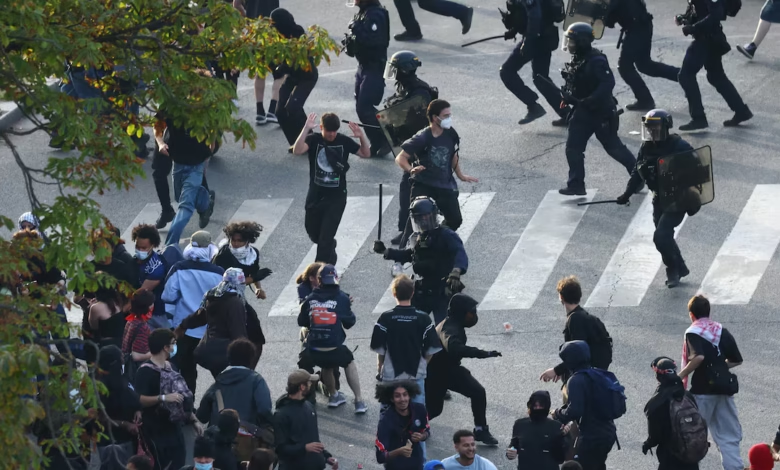
The demonstrations were largely peaceful in several cities, but clashes broke out in parts of the country.
Police used tear gas and baton charges in some locations to disperse protesters, while incidents of vandalism and confrontations with security forces were also reported.
Injuries and Arrests Mount
The escalation has come at a heavy cost.
Prime Minister Sébastien Lecornu said at least 215 teenagers and 85 school staff had been injured since the protests began.
More than 700 police officers and gendarmes have also been injured, while authorities have reported more than 6,100 arrests, most involving minors.
The injury of a 15-year-old who lost his hand after handling a police dispersal grenade during a confrontation in Lens has become one of the most serious incidents of the protests.
The incident has intensified criticism from rights groups and others who accuse French authorities of excessive use of force. Police and government officials, however, have pointed to violent incidents involving protesters and the need to maintain public order.
French authorities have also opened investigations into several incidents involving police conduct.
What the Students Want
The protests are centred on education.
Students and their supporters are demanding more teachers and support staff, better-maintained school buildings, improved classroom conditions and greater resources for public education.
They have also raised concerns about overcrowding, teachers who are absent without adequate replacements, long school schedules and inequalities associated with the Parcoursup university admissions system.
The movement began at a high school in Créteil, in the Paris suburbs, before spreading rapidly to other parts of France.
What started as a dispute over conditions in individual schools has now developed into a nationwide mobilisation involving students, parents, teachers and major trade unions.
Government Moves to Respond
The French government has acknowledged that some of the students’ grievances are legitimate while condemning violence and destruction.
Education Minister Édouard Geffray has launched an anonymous national consultation allowing lycée students to submit their concerns and proposals.
The government has also outlined measures focusing on teacher replacements, school buildings, the organisation of the school day, the university admissions process and mechanisms for ensuring that students’ views are considered.
The consultation is scheduled to run until October 23.
Prime Minister Lecornu has called on ministers to develop proposals addressing the education crisis, but the government’s ability to increase spending is constrained by France’s wider budgetary and debt pressures.
A Wider Crisis of Confidence
The protests have increasingly become about more than classrooms and teachers.
The mobilisation has emerged at a time of broader political and economic tension in France, with the government under pressure over public spending and national debt and a presidential election approaching in 2027.
For the students on the streets, however, the immediate issue remains the condition of the education system and their prospects for the future.
As demonstrations continue, the challenge for the government is becoming twofold: restoring public order while addressing the underlying grievances that brought thousands of young people into the streets in the first place.
With another day of mobilisation already being called by student organisations, the French government faces growing pressure to demonstrate that its response will go beyond policing the protests and deliver measurable improvements inside the country’s schools.
NEWS THAT INFORMS, MEDIA THAT TRANSFORMS