

ADEBOYE ADEBAYO’S OPINION
I personally cherish teachers a lot because both my parents were teachers.
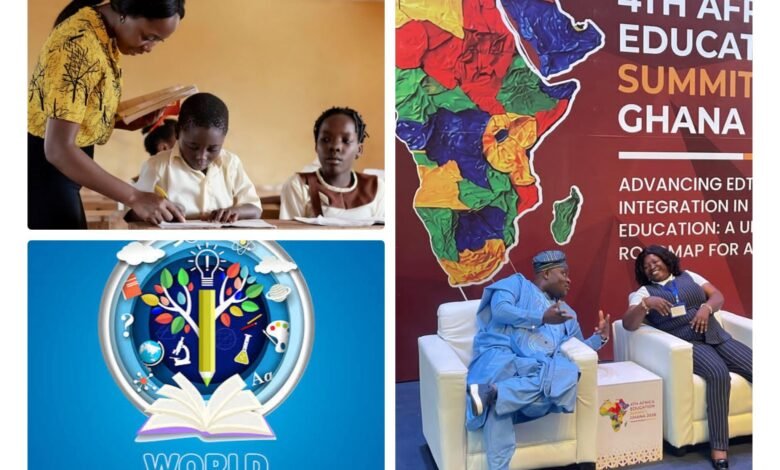
Earlier this year, I had the privilege of being in Accra, Ghana, for an education summit.
I went there expecting to listen, learn, exchange ideas and gain new perspectives on the challenges and possibilities surrounding education in Africa.
But sometimes, in the midst of many presentations, speeches and conversations, one particular sentence finds its way into your heart and refuses to leave. That happened to me in Accra.
One of the speakers said: “If your students and your pupils do not understand what you are teaching them, you have failed.”
I remember sitting there and thinking about the weight of that statement.
It was only one sentence, but it made me reflect deeply on what we expect from our teachers, what we provide for them and, most importantly, what our children deserve from us.
I have carried that statement with me since I left Accra.
I have replayed it in my mind because, at first hearing, it sounds like a harsh judgment of the teacher.
But the more I thought about it, the more I realised that it was actually not intended to condemn teachers; it was to challenge them.
A challenge to every person who has accepted the responsibility of standing before a child and saying, in essence, “I am here to help you learn.”
Today, October 5, as the world marks World Teachers’ Day, that reflection from Accra feels even more relevant.
UNESCO’s official theme for 2026 is: “Standing with teachers: 60 years of protecting the profession, advancing its status and shaping our futures.”
There is something profound about that theme.
Standing with teachers must mean more than celebrating them with speeches, social media posts and messages of appreciation once a year.
It must mean protecting the dignity of the profession, it must mean improving their working conditions, it must mean giving them the tools to teach, it must mean recognising their sacrifices.
But standing with teachers must also mean helping them fulfil the responsibility that comes with the profession; reaching the child.
And so, before anything else, I want to salute our teachers.
Across Africa, teachers are doing some of the most important work in our society under circumstances that are often incredibly difficult.
Many walk into overcrowded classrooms every morning, many work without adequate teaching materials, many operate in schools where infrastructure and basic facilities are insufficient, many are poorly remunerated.
And behind the teacher standing in front of that classroom is a human being who also has a life outside the school.
There are rent payments, there are children to raise, there are family responsibilities, there are personal disappointments, there are health, financial and emotional challenges.
There are days when the teacher may not feel strong enough to teach anybody, yet the bell rings, the children arrive and the teacher stands up and teaches.
That resilience deserves to be acknowledged. Our teachers deserve our respect, not pity. They deserve accolades and kudos to them.
But my reflection in Accra also reminded me of something else; the difficulties of the teacher or teaching must never make us forget the needs of the child.
The child sitting in that classroom does not know whether the teacher was paid on time, the child does not know that the school lacks the necessary teaching materials, the child does not know what personal battles the teacher fought before arriving at school that morning.
The child only knows whether he or she understands what is being taught.
And that is where the statement from Accra becomes particularly profound.
Teaching is not simply about speaking, it is not enough for a teacher to say, “I have taught this topic.”
The real thing should be: “Has the child understood it?”
If one method does not work, try another. If the explanation is too complicated, simplify it. If theory is not connecting with the learner, use practical examples. If a child is struggling, do not immediately label that child as unserious or incapable.
Who knows, the child needs the lesson presented differently or the teacher needs another approach and perhaps we simply need more patience.
Because the ultimate evidence of teaching is not that the teacher has spoken, it is that the learner has understood.
This is where the responsibility becomes collective.
We cannot place everything on the teacher and walk away.
Governments must create an environment where teachers can succeed.
Teachers must be properly trained, adequately supported and fairly remunerated.
Schools must have the infrastructure and learning materials required for effective teaching.
Parents must take a greater interest in what their children are learning.
And teachers, despite the difficulties they face, must never lose sight of the enormous privilege and responsibility that comes with shaping young minds.
Because the children sitting in those classrooms are not simply students.
They are our future.
The child struggling to understand mathematics today may become the engineer who builds tomorrow’s infrastructure.
The child discovering a love for science may become the scientist who solves a problem we have not yet been able to solve.
The quiet child sitting at the back may one day become a leader.
The child who currently struggles with reading may one day become the author whose words inspire millions.
We simply do not know.
That uncertainty is precisely why every child deserves our best effort.
So, to our teachers across Africa, I say: I salute you.
I recognise your sacrifices, I recognise the difficult environments in which many of you work, I recognise that some of you continue to give your best despite inadequate resources, poor remuneration and personal challenges that your students may never know about.
But I also appeal to you; please, do not give up on the child. Find another method, explain it differently, use another example. Be patient, be creative and try again.
Because somewhere in that classroom may be a child whose entire perception of his or her own potential changes simply because one teacher refused to give up.
And governments and policymakers at all levels should not demand extraordinary results from teachers while giving them ordinary or inadequate tools.
We cannot demand world-class education while providing third-class conditions for the people responsible for delivering it.
We cannot speak passionately about the future of Africa while neglecting the classrooms where that future is being shaped.
Education is not just another item on a government agenda.
It is the foundation upon which the future of our societies rests.
The teacher deserves dignity, he deserves support, she deserves fair remuneration, they deserve the tools to do the job.
But the child deserves something equally important; the right to understand.
That, for me, is the balance we must find.
Standing with teachers means standing up for their dignity and welfare.
It also means standing with them as professionals and challenging them to keep improving their skill and craft.
Because appreciation without accountability is incomplete and accountability without support is unfair, we need both.
Let us honour our teachers without lowering the standards expected from them.
Let us demand accountability without forgetting the difficult environment in which many of them operate.
Let us invest in teachers because investing in teachers is investing in the children.
And let us invest in the children because, ultimately, they are the ones who will inherit the society we are building today.
If we truly care about posterity, then we must understand that educating a child is not simply about preparing someone to pass an examination.
We are preparing someone to inherit our world.
That is the responsibility and that is the challenge.
And that is why the words I heard in Accra continue to stay with me.
Happy Teachers’ Day!!!
Comrade Adeboye Adebayo is a politician, entrepreneur, public affairs analyst, social commentator and a media executive.
News that informs, Media that Transforms.