

Reloaded News Desk
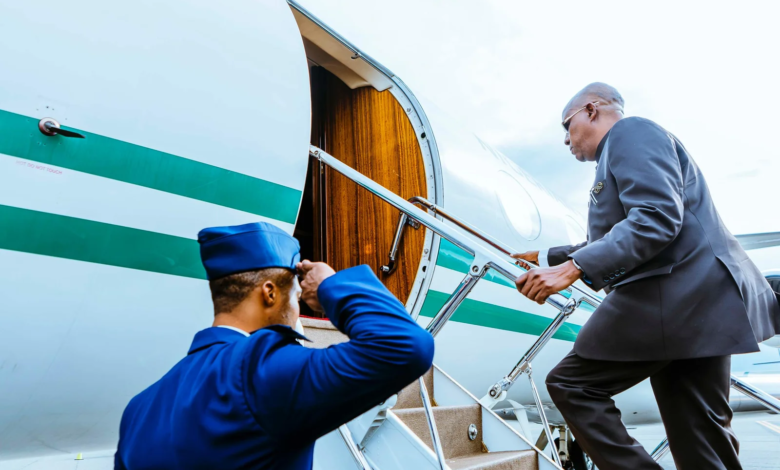
Vice President Kashim Shettima has departed New York for Abuja after a week of diplomatic, economic and multilateral engagements that went considerably beyond Nigeria’s national address at the 81st United Nations General Assembly.
Representing President Bola Ahmed Tinubu, Shettima led Nigeria’s delegation to the UNGA and used the New York gathering to pursue issues spanning Africa’s mineral resources, reform of global institutions, regional integration, education financing, investment, diaspora engagement and Nigeria’s broader diplomatic relations.
The seven engagements provide a clearer picture of the issues Nigeria placed before international partners during the visit.
Africa’s mineral wealth
One of Shettima’s earliest major engagements was the Third High-Level Roundtable of the Africa Minerals Strategy Group, where he called for a fundamental shift in how African countries manage their mineral resources.
He argued that Africa should move beyond exporting raw minerals and develop processing, manufacturing and value-addition industries around the continent’s critical resources.
For Nigeria, the discussion connects directly with its effort to attract investment into the solid minerals sector while retaining more economic value domestically. The Federal Government has repeatedly positioned mineral development as part of its broader diversification strategy.
UN reform and Africa’s place at the table
Shettima also met United Nations Deputy Secretary-General Amina Mohammed, with the conversation touching on Africa’s representation in the global governance system.
The Vice President reiterated Nigeria’s position that Africa’s continued exclusion from permanent membership of the UN Security Council undermines the fairness and legitimacy of the international system.
He said Nigeria would continue to support reforms aimed at making international institutions more representative and responsive.
The issue has become one of Nigeria’s recurring diplomatic priorities, particularly its demand for permanent African representation on the Security Council.
ECOWAS and the search for regional unity
Another significant engagement came when Shettima received the new President of the ECOWAS Commission, General Birame Diop, and his delegation in New York.
The meeting carried particular weight because of the continuing political reorganisation of West Africa following the withdrawal of Burkina Faso, Mali and Niger from ECOWAS and the emergence of the Alliance of Sahel States.
Shettima urged the new ECOWAS leadership to strengthen regional integration and deliberately build bridges with emerging blocs such as the AES.
He also called for greater private-sector participation in the Lagos-Abidjan Highway project and assured the ECOWAS leadership of Nigeria’s continued support.
The engagement placed Nigeria’s regional diplomacy alongside its wider UNGA programme rather than treating the New York visit solely as a global diplomatic exercise.
Nigeria-US minerals partnership
Nigeria’s mineral diplomacy also produced a concrete bilateral development during the UNGA week.
Minister of Solid Minerals Development Dele Alake and US Deputy Secretary of State Christopher Landau signed a framework for deeper cooperation in Nigeria’s mining sector.
The framework covers geological data and exploration, mineral development and processing, infrastructure and technical capacity.
The agreement does not itself constitute completed investment projects or new processing facilities, but it establishes a framework for cooperation in areas intended to support the development of Nigeria’s mineral industry.
The $5bn global education push
Education was another major component of Nigeria’s New York engagement.
Shettima participated in the high-level education financing event jointly associated with Nigeria and Italy and the Global Partnership for Education, which sought to mobilise $5 billion for education financing worldwide.
He argued that education should be treated as an investment in economic productivity, national prosperity and stability rather than simply as expenditure.
The campaign subsequently reported $3.5 billion in global commitments, comprising confirmed and anticipated sovereign pledges as well as co-financing commitments. Italy pledged €50 million to GPE programmes.
The event brought Shettima together with figures including UN Deputy Secretary-General Amina Mohammed, Italy’s Deputy Prime Minister Antonio Tajani, former Tanzanian President Jakaya Kikwete and education activist Malala Yousafzai.
Reaching out to Nigerians in America
Shettima also met members of the Nigerian diaspora at Nigeria House in New York.
The Vice President appealed to Nigerians living in the United States to contribute their expertise, capital, networks and intellectual capacity to Nigeria’s development.
He specifically pointed to education, healthcare, science and technology and agriculture as areas where diaspora expertise could support national development.
The meeting also gave the Vice President an opportunity to explain the Federal Government’s economic reforms and its efforts to attract investment and strengthen the economy.
The wider diplomatic programme
Beyond the substantive policy meetings, Shettima participated in the formal diplomatic programme surrounding the General Assembly.
He attended the welcome breakfast hosted by UN Secretary-General António Guterres for heads of delegation and their spouses before joining world leaders at the opening of the General Debate.
He also held bilateral and multilateral engagements involving foreign leaders, international organisations and development partners during the UNGA week. Nigeria’s Foreign Affairs Ministry had earlier briefed him on the country’s priorities and expected engagements for the session.
Taken together, the engagements show that Shettima’s New York mission extended across several levels of Nigeria’s foreign policy.
There was the question of Nigeria’s place in global institutions; the push for African representation in global decision-making; the effort to strengthen ECOWAS integration; the search for investment and technology in the minerals sector; the mobilisation of international education financing; and the attempt to bring Nigerians abroad more directly into national development.
His departure from New York therefore closes more than Nigeria’s participation in the UNGA General Debate.
It marks the end of a week in which the Federal Government used the presence of governments, international institutions, investors, development partners and the Nigerian diaspora in one city to pursue several interconnected national and continental interests.