

Reloaded News Desk
President Bola Ahmed Tinubu has called for a fundamental restructuring of the United Nations Security Council, stronger international cooperation against terrorism and transnational crime, greater access to development financing and a more equitable global order.
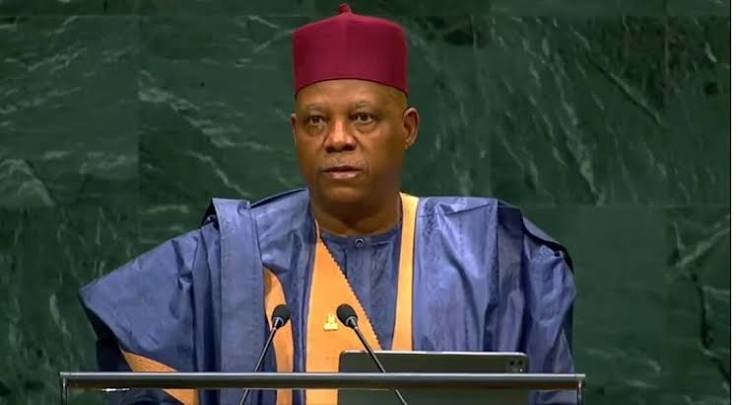
The President made the call in Nigeria’s national statement at the General Debate of the 81st Session of the United Nations General Assembly in New York on Thursday.
Vice-President Kashim Shettima delivered the address on behalf of President Tinubu.
Tinubu congratulated the President of the 81st General Assembly and pledged Nigeria’s cooperation and support for the session.
He also commended the leadership of the United Nations and stressed the need to restore confidence in multilateral institutions at a time when conflicts, insecurity, economic pressures and global inequalities continue to test international cooperation.
CONFLICTS AND THE PURPOSE OF THE UN
Tinubu said the persistence of conflicts around the world remained a reminder of why the United Nations was established — to prevent future generations from experiencing the devastation of war.
He called for a return to dialogue, mutual respect and collective responsibility.
Nigeria, he said, remained committed to the UN Charter and to a global system where diplomacy takes precedence over coercion, cooperation over isolation and international law over arbitrary exercises of power.
He warned against a world in which propaganda could distort the distinction between victims and aggressors.
“We should all be afraid of a world in which we can no longer tell the victim from the aggressor,” he said.
Tinubu added that when propaganda shields perpetrators from justice and makes truth-telling a crime, the fundamental promise of the United Nations is undermined.
NIGERIA DEMANDS PERMANENT AFRICAN SEATS
The President renewed Nigeria’s demand for reform of the UN Security Council, arguing that its present structure reflects the distribution of global power in 1945 rather than the realities of 2026.
He called for at least two permanent seats for Africa, with the full rights and responsibilities of permanent membership, including veto power for as long as the veto remains part of the Council’s structure.
Nigeria also demanded five non-permanent seats for Africa.
The position was presented in accordance with the African Union’s Ezulwini Consensus and Sirte Declaration.
“Africa cannot continue to fill the Council’s agenda while remaining absent from its permanent membership,” Tinubu said.
He argued that those with the authority to speak for humanity must also have an obligation to represent humanity.
AFRICA’S DEVELOPMENT
Tinubu said Africa must move beyond dependence on the export of raw materials and pursue greater value addition, manufacturing, technological innovation and knowledge-driven economic growth.
He said Nigeria would continue to support efforts aimed at strengthening African economic integration and creating conditions for sustainable development.
The President linked peace and development, arguing that economic progress cannot take root where violence continually destroys livelihoods, while lasting peace remains difficult where injustice and exclusion persist.
TERRORISM AND TRANSNATIONAL CRIME
Nigeria called for stronger international cooperation against terrorism, organised crime, cyberattacks and illicit financial activities.
Tinubu urged countries to improve intelligence sharing, strengthen institutions, disrupt the financing of violent groups and prevent the movement of illegal weapons across borders.
He said Nigeria’s experience in confronting Boko Haram, ISWAP and other armed groups had demonstrated that military operations alone could not provide lasting solutions.
According to the President, sustainable security also requires education, economic opportunity, accountable governance and protection of citizens’ rights and dignity.
He said instability in the Sahel could quickly affect neighbouring countries by displacing populations, weakening regional integration and threatening democratic governance.
Nigeria therefore reaffirmed its commitment to working through ECOWAS, the African Union and international partnerships to confront regional security challenges.
PEACEKEEPING AND CONFLICT RESOLUTION
Tinubu reaffirmed Nigeria’s support for peaceful settlement of disputes under the UN Charter.
He called for greater investment in peacekeeping, peacebuilding, mediation and institution-building.
Nigeria’s contributions to peace efforts in Liberia, Sierra Leone, Darfur, Mali and The Gambia, he said, reflected the country’s continuing commitment to international peace and security.
The President also called for urgent diplomatic attention to conflicts, including the crisis in Sudan.
CLIMATE CHANGE AND ENERGY
On climate change, Tinubu said developing countries should not be forced to choose between economic development and climate action.
He argued that developing countries must be allowed to industrialise, reduce poverty and expand access to energy while pursuing lower-carbon development pathways.
Nigeria reaffirmed its commitment to the Paris Agreement and its Energy Transition Plan, which targets net-zero emissions by 2060.
Tinubu called for greater technology transfer and climate financing to enable developing countries to pursue sustainable development without sacrificing their economic prospects.
REFORM OF GLOBAL FINANCIAL SYSTEM
The President also called for reforms to the international financial architecture.
He said developing countries require greater access to concessional financing and debt sustainability arrangements that properly recognise their developmental needs.
According to Tinubu, high debt-servicing burdens can divert resources that should otherwise go towards education, healthcare, infrastructure and other essential areas of development.
He called for a global financial system capable of supporting countries seeking sustainable economic growth.
ARTIFICIAL INTELLIGENCE AND TECHNOLOGY
Tinubu said Nigeria would continue to embrace technological development, including artificial intelligence.
He rejected an approach driven solely by fear of emerging technologies, arguing that the impact of AI would ultimately depend on how humans choose to develop and deploy it.
Nigeria, he said, was expanding digital public infrastructure, improving broadband access and supporting technology entrepreneurship.
NIGERIA’S GLOBAL ROLE
The President said Nigeria remained committed to international cooperation and would continue to contribute to efforts aimed at strengthening peace, security, development and multilateralism.
He argued that no country could completely insulate itself from threats that cross national borders, making international cooperation essential.
Tinubu concluded by calling for a United Nations that is more representative, effective and capable of responding to the realities of the contemporary world.
He said a reformed and inclusive UN remained essential to achieving a peaceful, just and sustainable future.
“Whatever our differences, we must remember that humanity is our oldest citizenship, and peace is the inheritance we owe every child,” he said.
Reloaded News — NEWS THAT INFORMS. MEDIA THAT TRANSFORMS