



By Gerald Ekwunife
There is a curious irony in the latest quarrel between Governors of the ruling APC and the Minister of the Federal Capital Territory, Nyesom Wike.
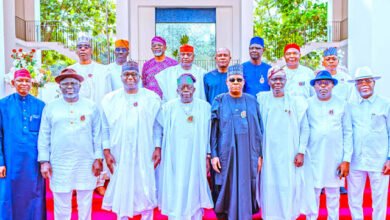
The APC governors say they are protecting the party from a political arrangement capable of weakening APC candidates and undermining President Bola Ahmed Tinubu’s 2027 re-election.
Fair enough. That is precisely what a governing party is expected to do.
But before APC turns Nyesom Wike into its latest political enemy, perhaps its so-called Progressive Governors should first look in the mirror.
What exactly are they fighting: Wike, or the consequences of the many avoidable political problems that some of them created in their states in the first place?
On September 14, the Progressive Governors Forum declared that its members would neither participate in, support nor endorse any alliance capable of weakening APC or adversely affecting its candidates.
Wike’s response was characteristically Wike: combative, abrasive, personal and unnecessarily below the belt.
For the record, I have always disagreed with that aspect of his politics and persona. Calling governors “politically lazy” and “failures”, for instance, does not improve an otherwise legitimate political argument or cause.
But separating Wike’s temperament from the substance of his argument is important.
He has consistently maintained that he supports President Tinubu’s government and/or re-election and that he is not joining APC. His “Rainbow Coalition”, as he describes it, allows politicians from different parties to support Tinubu at the presidential level while pursuing their individual political aspirations on other platforms at state and legislative levels.
Wike has also said he never approached the APC Governors Forum seeking an alliance.
Wike’s coalition arrangement may be politically inconvenient to APC governors. It is not, however, too difficult to understand. Cross-party alliances are hardly unusual in politics across the globe.
The real question, therefore, is this:
Why is this coalition arrangement increasingly finding willing participants from across party divides?
A political party does not suddenly become vulnerable simply because another politician is clever enough to attract its members. It becomes vulnerable when its own members become sufficiently aggrieved to look elsewhere.
And that is already happening in several places within the APC.
Benue. Nasarawa. Adamawa. Gombe. And many other states in the country where the ruling party holds sway.
Kwara is perhaps the most instructive example.
There, for instance, Senator Saliu Mustapha, a prominent APC figure who contested the party’s disputed governorship primary, subsequently left APC after also being denied a return ticket to the Senate by the State Governor and emerged as the PDP candidate for Kwara Central. Other prominent hitherto-APC politicians, under a so-called “G15” tag, have also moved into the emerging anti-AbdulRazaq political alignment.
Whatever one’s preferred interpretation of the Kwara crisis may be, one fact is beyond dispute: contentious primaries and poorly managed internal party disagreements have produced worrisome political realignments outside the ruling party in that state, as in many other state chapters of the APC, no thanks to its “Progressive Governors.”
That should concern every APC member.
And it is not merely a Kwara question. Similar tensions exist in several APC states across the country.
When major politicians and critical party stakeholders who have spent years building a party become alienated after questionable primaries, the strategic question should not simply be:
How do we stop them from leaving or render their departure ineffectual?
It should first be:
Why did they become alienated in the first place?
A party that wins every internal battle but loses the loyalty of important stakeholders may discover too late that it has won the primary but lost the election.
One may dislike Wike’s language, methods or politics. But one thing cannot reasonably be denied: Wike understands political organisation.
He understands elite bargaining and consensus building. He understands political loyalty and grassroots mobilisation. He understands the importance of maintaining political relationships beyond formal party boundaries.
Above all, he understands that elections are won not merely by issuing statements from party headquarters, but by building structures that reach the ward, polling unit and community.
That is why his intervention should make APC governors uncomfortable — not necessarily because Wike is invincible, but because he is exposing a major, crying weakness of theirs.
If an APC member who loses a primary can be persuaded to leave APC and subsequently become part of a coalition that still supports Tinubu for President, then the obvious question is:
Why was APC unable to keep that person within its own fold in the first place?
That is the question we should be trying to answer.
Wike has also challenged APC governors over their ability to deliver presidential votes. This is not an entirely frivolous argument.
Vice-President Kashim Shettima said this week that only six of the 19 northern governors supported Tinubu’s presidential ambition in 2023, identifying former Niger Governor Abubakar Sani Bello and Kwara Governor AbdulRahman AbdulRazaq among them.
That is a remarkable statement coming from the Vice-President.
It reminds us that being a governor is not synonymous with possessing unlimited political influence.
The 2023 experience demonstrated precisely that distinction.
So when Wike asks governors to demonstrate their capacity to deliver the President rather than merely assert their political influence, there is a legitimate question underneath that provocative statement.
Suppose disgruntled APC politicians leave and join another party such as the ADC or NDC whose presidential candidate is committed to defeating Tinubu in 2027. That is obviously a problem for APC.
Would the so-called Progressive Governors prefer that situation to one in which those they have sent out of APC join Wike’s Rainbow Coalition, where they could still support Tinubu at the presidential level while pursuing their political ambitions elsewhere?
If aggrieved APC members join another opposition platform with significant regional strength and jointly campaign against APC candidates, the party has another problem on its hands.
But suppose instead that they join a Rainbow Coalition arrangement that permits them to pursue their ambitions outside APC at state level while still supporting Tinubu at the presidential level.
Isn’t that a fundamentally unique but safer political equation for the APC?
Whether APC likes it or not, Wike is offering some disgruntled APC politicians and members a safer alternative political destination.
And the existence of that destination should provoke introspection, not panic, from wiser and much more politically calculative APC members.
The answer to APC’s current predicament cannot be to declare war on everyone who refuses to remain politically homeless.
The answer should be to make APC sufficiently inclusive, sufficiently democratic and sufficiently politically intelligent that its members do not feel compelled to seek accommodation elsewhere.
There is another matter APC governors should examine before fighting everybody else:
What exactly have they been doing with the enormous political and fiscal opportunities available to them under this Tinubu reform government?
President Tinubu’s reforms have imposed expected difficult but necessary hardship on Nigerians. That hardship is real.
The administration has consequently introduced intervention programmes aimed at cushioning the effects of the adjustment. But the Federal Government cannot carry the entire burden of social protection, human capital development and grassroots development alone.
State governments have responsibilities too
This is where local-government autonomy becomes particularly important.
President Tinubu’s administration took the Federal Government’s case for local-government financial autonomy to the Supreme Court, which in July 2024 affirmed the constitutional rights of local governments to financial autonomy.
Yet implementation remains contested.
The broader point is simple: when the benefits of government do not sufficiently reach the grassroots, the political consequences eventually travel upwards.
The woman in a remote village does not care about an Abuja press conference. She wants a functioning health centre.
The farmer wants an accessible road.
The child needs a functioning school.
The trader needs a functioning market.
The young person needs an economic reason not to abandon his community for Abuja, Lagos, Port Harcourt or Enugu.
That is what grassroots politics is not only meant to entail but address.
And that is also why political organisation matters.
How many people have the governors truly empowered or lifted at the sub nationals where they are in charge?
How many APC faithfuls, support groups or ordinary party members can genuinely point to their state governors and say: “This governor or government changed my life”?
If these governors have attended to the people in their domains in significant numbers, would they be so afraid of political alliances against them — whether led by Wike or anyone else?
Let us face it and tell ourselves the home truth: unlike most of these governors, progressive or not, Wike’s political strength has always rested substantially on his ability not only to handsomely repay political loyalty, but also to build and maintain a formidable political structure at the grassroots.
Whether one admires Nyesom Wike’s methods or not, APC governors should ask themselves whether they are doing enough to similarly reward their party members or build resilient structures based on inclusion, empowerment and consensus.
This is not a call for APC to surrender its candidates.
It is not a call for APC governors to support candidates of other parties.
It is not even a call to embrace Wike’s Rainbow Coalition.
It is a call for something much simpler:
Let APC stop creating political refugees and then complain when somebody gives them safe shelter elsewhere!
If party members are angry because they believe they have been unfairly treated, listen to them.
If stakeholders feel excluded, reconcile with them.
If politicians lose primaries, manage the consequences intelligently.
If governors have damaged relationships with important party leaders, repair them.
If grassroots structures are weak and members complain of abandonment, strengthen the structures and attend to the complaints of your foot soldiers.
Above all, if President Tinubu’s re-election is genuinely the overriding objective of every APC political actor, then these una “Progressive Governors” should be seeking what strengthens not weakens, the President’s electoral coalition and/or chances.
Wike is not the issue here, please!
After all, if these so called Progressive Governors have truly done well and held their APC state chapters together, would they be afraid of Wike’s coalition – or anybody else’s?
In fact, Wike should be the very last 2027-related worry to cross the minds of APC governors.
The deeper issue is whether or not APC can manage its own family and internal affairs.
The greatest threat to a political party is not always the man standing outside its gate.
Most times, it is the accumulation of many angry but quiet men and women inside the house whom nobody bothered to recognise or attend to before they walked out.
So, before APC fights Wike, let their so-called “Progressive Governors” look in the mirror.
The reflection may tell them considerably more about the 2027 challenges waiting for them than Wike’s latest television interview ever could.
But if these APC Governors fail to read the room or decipher the clear 2027 handwriting on the wall; or if they think they can turn the entire membership of APC in Nigeria against Nyesom Wike, trust me, e no go work.
And in the very unlikely event that it does work, they may likely win the battle by getting Wike removed as FCT Minister, only to lose the war by losing legislative seats, LGAs and not a few governorship seats.
A word, they say, is enough for the wise – but in this case, for the politically discerning
Ekwunife Gerald Ogbonnaya, Esq.
Lawyer | Public Policy Analyst | Governance Affairs
Abuja | FCT