

By Reloaded News Desk
Sixty-six years ago, Nigeria stepped into independence carrying an enormous promise.
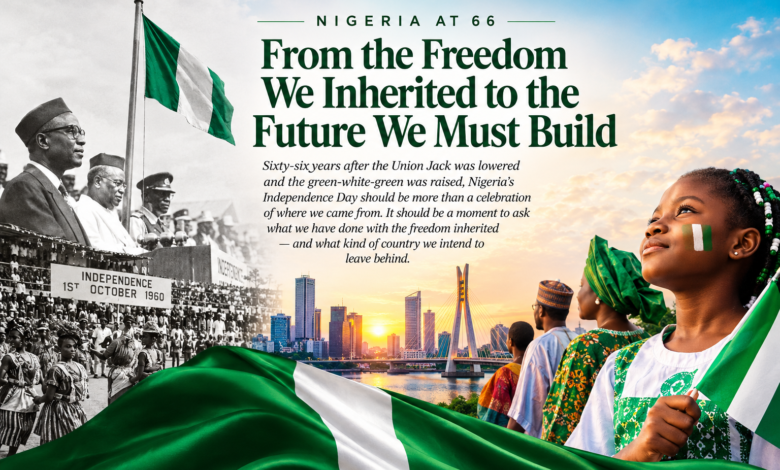
On October 1, 1960, the Union Jack was lowered and the green-white-green flag was raised over a sovereign Nigeria. The country inherited the responsibility of governing itself after decades of British colonial rule, beginning a national journey whose story would be marked by ambition, achievement, crisis, conflict, recovery and an enduring search for what Nigeria could become.
The Federal Government, in marking the 66th anniversary, has described the occasion as an opportunity to reflect on the contributions and sacrifices of the country’s founding fathers and on the journey since independence.
But Independence Day is more than an anniversary, it is a question of What have we done with the country we inherited?
THE PROMISE OF 1960
Nigeria entered independence as a federation of three regions, with a parliamentary system and substantial regional responsibilities. The independence constitution provided for a federal government headed by a Prime Minister, with a Governor-General as head of state.
The circumstances were different from today, but the fundamental national challenge was already clear; how could a country of different peoples, cultures, religions, languages and political interests build one functioning nation?
The founding generation believed Nigeria could become a major force in Africa and beyond.
They inherited enormous agricultural potential, natural resources, emerging educational institutions and a population whose aspirations were expanding with the opportunities created by self-government.
Yet independence did not erase the difficulties inherited from colonial rule.
The new country still had to construct national institutions, expand education, develop infrastructure, build an industrial base and manage political competition within a deeply diverse federation.
The First Republic lasted only a few years before the military intervened in January 1966. Nigeria would subsequently experience a civil war, prolonged periods of military rule, economic crises and political upheaval before returning to the current democratic era in 1999.
The journey has therefore never been a straight line.
SIXTY-SIX YEARS OF CONTRADICTIONS
Nigeria’s story is difficult to reduce to either success or failure.
The country has produced world-class professionals, entrepreneurs, academics, artists, athletes and technology innovators. Nigerian businesses operate across Africa and beyond. Nigerian culture has become globally influential.
The country has also expanded its educational institutions, telecommunications infrastructure, financial system, urban centres and private-sector economy in ways that would have been difficult to imagine in 1960.
Yet enormous problems remain.
Millions of Nigerians still struggle with the cost of living. Electricity supply remains inadequate for the country’s ambitions. Infrastructure deficits continue to constrain businesses and communities. Security challenges persist in parts of the country. Education and healthcare require sustained investment, while the country’s productive capacity remains below its potential.
These contradictions are at the heart of the Nigerian question.
How can a country with such resources, talent and entrepreneurial energy continue to struggle to convert its potential into broadly shared prosperity?
ECONOMY; THE CENTRAL TEST
Perhaps no issue better captures Nigeria’s post-independence journey than the economy.
Nigeria’s economic structure has changed dramatically over six decades. Agriculture once dominated economic activity and exports. Oil subsequently became central to government revenue and foreign exchange earnings. Today, services, telecommunications, technology, finance, entertainment and other sectors occupy increasingly important positions alongside oil and agriculture.
But diversification remains a national objective.
The present administration argues that the economic reforms introduced since 2023 are laying the foundation for greater production, investment and prosperity. At the government’s 66th Independence Anniversary activities, officials said the next phase should be about translating economic stabilization into jobs, higher incomes and wider opportunities.
President Bola Ahmed Tinubu, in his Independence Day address, similarly declared that Nigeria was moving from what he called the “age of reform” to an “age of prosperity.”
When the promised prosperity will reach ordinary Nigerians will ultimately be judged not by speeches but by what happens to household incomes, employment, food prices, electricity, transportation, housing and access to opportunity.
That is the real test of economic policy.
THE DEMOCRATIC QUESTION
Nigeria’s return to democratic government in 1999 marked another major turning point.
More than two decades later, democratic rule has become the longest uninterrupted period of civilian government in the country’s post-independence history.
That continuity means a lot.
But democracy is not simply the holding of elections.
It also requires institutions that command public confidence, accountability in the exercise of power, respect for the rule of law, credible public services and meaningful opportunities for citizens to participate in the affairs of their country.
The strength of Nigeria’s democracy will therefore depend not only on who occupies political office but on how effectively the institutions of the state serve the people.
THE YOUNG COUNTRY WITH A YOUNG POPULATION
Perhaps the greatest difference between Nigeria of 1960 and Nigeria of today is the scale and character of its population.
Nigeria is now overwhelmingly a young country, and millions of young Nigerians are entering an economy that must create opportunities at a pace capable of matching their aspirations.
This presents both a challenge and an extraordinary opportunity.
A young population can become the engine of innovation, production and economic expansion.
But without quality education, relevant skills, productive employment and access to capital, the same demographic reality can deepen economic and social pressures.
Nigeria’s future will therefore be determined to a significant extent by what it does with its young people.
THE COUNTRY WE MUST BUILD
At 66, what went wrong does not matter anymore, what we can do differently and rightly should come next.
Nigeria does not need another generation of promises without implementation.
It needs productive farms, functioning industries, reliable electricity, efficient transportation, quality schools, accessible healthcare, secure communities and institutions capable of delivering public services.
It needs an economy where success is increasingly determined by productivity and innovation rather than proximity to political power.
It needs a political culture in which national interest is not permanently subordinated to ethnic, religious, regional or partisan calculations.
And it needs citizens who understand that nation-building is not the responsibility of government alone.
The government has a duty to govern well.
Institutions have a duty to function.
Businesses have a duty to create value and jobs.
Citizens have a duty to obey the law, demand accountability and contribute to their communities.
The country cannot be rebuilt by government announcements alone.
1960: A BEGINNING; NOT A DESTINATION
The men and women who fought for independence could not have known what Nigeria would look like 66 years later.
They could not have predicted the internet, smartphones, digital banking, artificial intelligence or the extraordinary global influence of Nigerian music and film.
They could not have predicted the size of today’s cities or the scale of Nigeria’s entrepreneurial class.
But they understood one fundamental principle:
The future would ultimately belong to Nigerians themselves.
That responsibility remains.
Nigeria at 66 is neither the country of 1960 nor the country it will be in 2060.
It is a country still being built.
The question for this generation is whether we will simply inherit the contradictions of the past or use what we have learned to construct something better.
Independence gave Nigeria sovereignty.
The next stage of the national project is to turn that sovereignty into security, productivity, dignity and broadly shared prosperity.
That is the unfinished work.
And that is the Nigeria we must build.